Most people have never actually answered the question. Not really. What would you wear if no one was ever going to see it? Not your partner. Not the hypothetical version of someone whose opinion you're still subconsciously dressing for. Just you, in a room, alone, with full permission.
The answer is more complicated than it should be. And that complication is worth paying attention to.
The Audience Problem
We learn to dress for reception before we ever learn to dress for ourselves. What reads as attractive. What signals something. What a body is supposed to look like inside certain fabric. That training starts early and it doesn't stop just because you close the bedroom door.
Even solo, even at midnight, even reaching into a drawer when no one is home: there's often still a ghost audience. The ex who had opinions. The cultural idea of what lingerie is for. The version of yourself you think you're supposed to inhabit by now.
None of that is you. That's just noise that got there first.
What Sensation Actually Means Here
Not pleasure in the charged sense, necessarily. More like: what does this fabric do to the skin it's touching? Heavy cotton that sits like an anchor. Thin silk that moves when you move and feels like it's barely there. A robe so weighted it becomes its own kind of embrace. Modal that's so soft it almost doesn't register.
These are not neutral choices. They're micro-decisions about how you want to inhabit your own body on a given night.
The specific weight of a waistband. Whether something sits loose or close. The temperature difference between satin at room temp and satin after your body has warmed it. These things matter because they're happening to you, not to an observer.
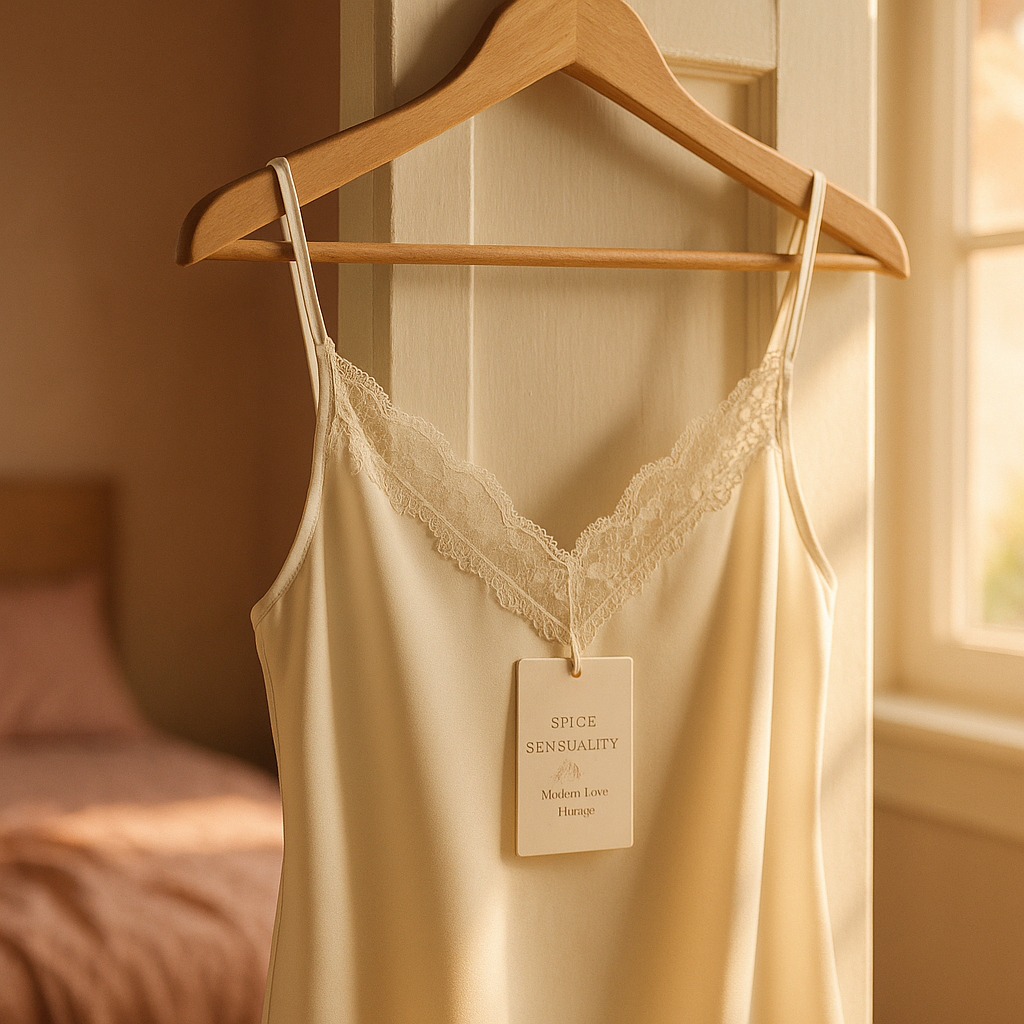
She bought the slip for herself two years ago and still hasn't worn it for anyone. It's hers in a way the other pieces aren't.
— reader, 34, San Francisco
The Specific Thing Fabric Does
Silk on the back of the knee is a different experience than silk on the shoulder. Lace that you find aesthetically interesting in your hand can feel like mild static against skin after an hour. What photographs beautifully and what you'd actually sleep in are almost never the same thing.
Most lingerie is designed to be looked at. The majority of the design language: the architectural underwire, the strategic cutout, the sheer panel, all of it is built for a viewer. That's fine. But it means the garments designed purely for the wearer's experience are rarer. And finding them requires asking a different question at the start.
Not does this look good. But: does this feel like something I'd choose again tomorrow morning?
The Recognition Moment
There's a specific thing that happens when you wear something that's actually yours. Not aspirationally yours. Not wishfully yours. Actually yours, chosen for your own reasons, fitting the body you have today rather than a future edited version.
It's a small recognition. A quiet settling. Like your body exhales slightly. That's not mystical. It's just what it feels like when something fits without agenda.
Some people find it in oversized cotton at ten PM. Some find it in something structured and specific: a particular cut of brief, a tank in a certain weight, a chemise in a color they'd never explain to anyone. The point isn't the item. It's the recognition that happens when you stop filtering through imagined eyes.
How to Actually Figure Out What You'd Choose
This isn't a shopping guide. But it is practical. Start by noticing what you reach for when you're not performing anything for anyone. Not what you own. What you actually reach for. There's probably a pattern.
Then ask: is that pattern about comfort in the avoidant sense (I gave up, this is fine) or comfort in the actual sense (this is the specific texture I want against me tonight)? Those are not the same thing. One is accommodation. The other is preference.
The next question: what have you not worn because you were waiting for a reason? For the right night, the right audience, the right body, the right moment. That waiting is worth examining. It usually has nothing to do with the garment.
When Solo Dressing Becomes a Private Ritual
There's a difference between getting dressed and putting something on deliberately. The deliberate version: you've thought about how you want to feel for the next few hours. You're not performing that for the empty room. You're just living inside it.
A weeknight. Warm shower, still steaming. You pull on something specific, something you chose, and the temperature difference between the fabric and your skin does exactly what you knew it would. That's it. That's the ritual. It doesn't need more scaffolding than that.
This is closer to self-knowledge than it is to self-care in the buzzword sense. It's low-stakes and physical and completely private. Which is exactly why it matters.
What This Has to Do with Desire
Knowing what you like against your skin when no one is watching is actually foundational information. It tells you something about how you experience your own body. Not the body that shows up for other people, which is always slightly performed. The one that exists at eleven PM with the door closed.
People who have a clear private relationship with their own sensory preferences tend to know what they want in other contexts too. Not as a rule. But it makes sense. The same muscle that reaches for the right fabric alone is the one that knows what to ask for when the stakes feel higher.
And the reverse is also true. A long habit of dressing purely for audience, of never really asking what you want it to feel like, can make that question harder to access everywhere else.
A Simple Starting Place
Tonight. One thing. Not a shopping decision, just an existing-wardrobe decision. What would you reach for if the only criterion was how it feels against your body for the next three hours?
Wear that. Don't justify it to yourself. Don't make it mean something. Just notice whether there's a small version of that recognition feeling: your body knowing it got something right.
If there isn't, that's information too. Maybe the drawer needs a different edit. Maybe the question has been waiting longer than you realized.
I stopped buying things I'd wear for someone else and started buying things I'd wear on a Tuesday when I'm just home. My drawer is smaller. I reach into it differently.
— reader, 41, Healdsburg
That's the whole point. Not the drawer. The reaching differently.