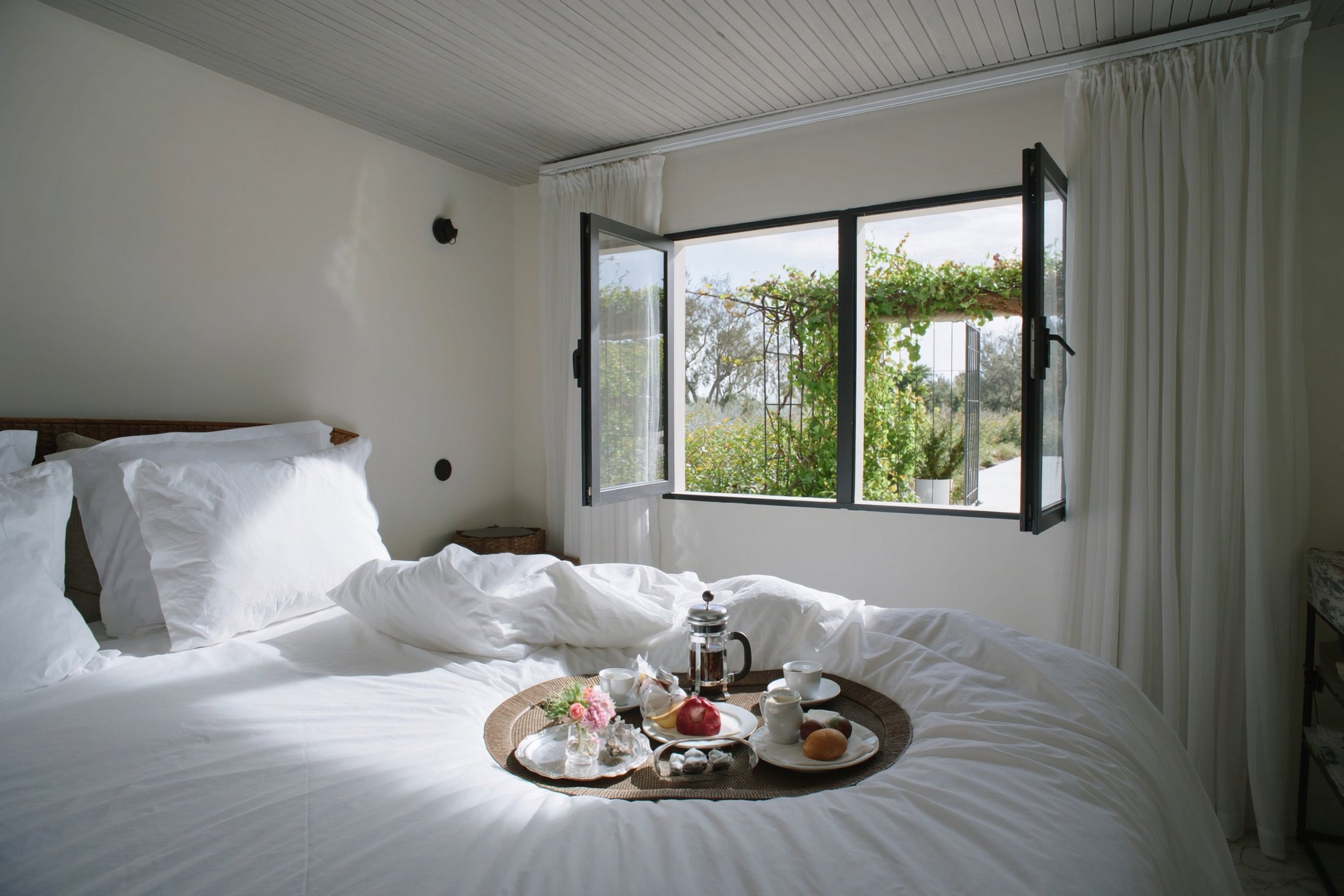
You stopped seeing the bedroom. Not consciously. It just happened the way all familiarity happens: gradually, then completely. The pile on the chair became part of the chair. The overhead light you swore you'd replace is still there, casting its flat, punishing glow over everything. The sheets are clean. The vibe is nowhere.
This isn't about your relationship. Or maybe it is, a little. But let's start with the room.
Why the Bedroom Goes Dead
The bedroom is the room you use most and design least. It absorbs everything: the laundry, the charging cables, the Sunday-night dread, the good conversations that happen in the dark. It becomes ambient. Invisible.
Hotels feel different because strangers made decisions you stopped making. They chose the light temperature. They edited the surfaces. They put exactly two things on the nightstand. You walked in and felt something. That feeling is available in your own room. It just requires a few deliberate hours and the willingness to actually look.
Start With Light — It Does More Than You Think
Overhead lighting is the enemy of atmosphere. That's not an exaggeration. A single overhead bulb at 5,000 Kelvin will flatten a room, flatten a mood, and make everyone look slightly tired and slightly annoyed. This is the first fix.
Two or three light sources at different heights, all warm (2,700K or below), will change the room more than any furniture purchase. A lamp on each side of the bed. Something low, maybe on a dresser. Dimmer switch if you can manage it. The overhead stays off after 8 PM. That's a rule now.
Candles work, too — not as performance, just as physics. Flame moves. Movement reads as warmth. The brain responds. It's not complicated.
The Surface Problem
Stand in the doorway and look at the room like you've never seen it. Count the surfaces. Now count what's on them. There's your problem.
Flat surfaces accumulate objects the way inboxes accumulate email: automatically, without intention, until the noise becomes the baseline. The nightstand has three chargers, a book you finished two months ago, a receipt, and something you meant to put away.
Clear one surface completely. Don't decorate it yet. Just leave it empty for a day and notice how the room breathes differently. Then add back only what you actually use or what you actually like. Not both — either.
The room you share is a continuous conversation between two people who've mostly stopped speaking through it.
— MLL
What the Bed Is Actually Doing
The bed is the room. Everything else is context. And the bed communicates something — whether you intend it to or not.
Pillows piled as armor. A bedspread so thick and territorial it functions as a wall. Sheets that feel like a good intention that wore out. These are micro-signals you stopped clocking because you've slept under them for three years.
One new sensory element on the bed changes it faster than you'd expect. Not a full remodel: one thing. A throw in a texture that surprises you — linen, velvet, something with actual weight. New pillowcases in a color you chose on purpose. The body notices before the brain does.
The Smell You've Stopped Smelling
Olfactory adaptation is real. You cannot smell your own bedroom anymore. Your partner can, a little. A guest absolutely can.
This isn't about shame. It's about the fact that scent is the fastest route to mood, and you've accidentally opted out of it. A room diffuser with a single clean note — cedar, eucalyptus, something light and specific — reintroduces the room to your senses. Not a candle named after a season. A real scent that means something, or at least doesn't mean nothing.
Sheets washed with a eucalyptus rinse. A cedar block in the closet. Lavender on the pillow if you're into it, but only lightly — this isn't a spa, it's your bedroom, and there's a difference.
The Phone Is Furniture Now — Address That
The phone on the nightstand is furniture at this point. It has a permanent spot. It charges there. It lives there. It's often the last thing you look at and the first thing you reach for, and somewhere in that routine the bedroom became an extension of your inbox.
Move the charger to the other side of the room, or outside the room entirely. Not as a wellness practice. As an environmental fact: the phone can't be on the nightstand if the charger isn't there. The room becomes different after about four days. So does the quality of whatever happens before you fall asleep.
Temperature and Weight
The body responds to temperature before anything else. A cool room and a heavy blanket is one of the oldest physical comforts available. If you've been sleeping at 72 degrees with a thin duvet, drop the thermostat and add weight. The difference is immediate and slightly embarrassing — you'll wonder why you waited.
Same logic applies to the robe on the hook behind the door, if you have one. Weight matters. Waffle cotton, heavy linen, something that feels like it chose you back. The sensory environment of a room extends past the bed.
The One Ritual That Actually Resets a Room
Not a renovation. Not a re-decoration. A ritual. Same time, every night, takes about ninety seconds.
Overhead light off. Warm lamp on. One surface cleared or straightened. Phone moved. Maybe a candle. That's it. You're telling your nervous system the day is over and the room belongs to you now.
Do it alone the first week. Then it becomes the thing you both do, or one of you does, and the other notices without naming it. That's the version that holds.
What This Is Actually About
Resetting the bedroom isn't a metaphor for resetting the relationship. Sometimes it's literally just the room. The room where you sleep, where you're most honest, where the day ends and sometimes something good happens before it does.
But a room you've stopped seeing is a room you've stopped inhabiting with any intention. And intention — small, specific, sensory — is what turns a place you sleep into a room that does something for you.
Start tonight. One lamp. One cleared surface. The overhead light stays off.
See what you notice.