Most couples aren't struggling because they've stopped caring. They're struggling because they've never changed a single lightbulb.
That sounds reductive. It isn't. The physical environment you share is doing constant, invisible work on your relationship — nudging you toward certain behaviors, making others feel effortful or just slightly out of reach. It's not dramatic. It's a dimmer switch that only goes to fluorescent, a bed positioned so the first thing you see is a pile of laundry, a living room optimized for watching screens in parallel.
You adapted to these things so gradually you stopped noticing them. But they're still there, every evening, quietly running the show.
The Room Is Already Making Choices For You
There's a concept in behavioral design called a default path — the option that happens if you do nothing. In your home, the defaults are: overhead lights, a couch aimed at a TV, phones within arm's reach, a bedroom that doubles as a home office, and a bed you collapse into rather than arrive at.
Those defaults aren't neutral. They're a set of instructions your space is giving you every night. Sit here. Stare here. Scroll here. Fall asleep mid-sentence here.
The hotel room effect is real — couples report feeling closer, more playful, more interested in each other in hotel rooms. Rarely because of the thread count. Mostly because the defaults are different. There's a lamp that only makes warm light. There's nowhere obvious to put your laptop. There's a bed that is, visually, the entire point of the room.
Lighting Is Not Aesthetic. It's Physiological.
Overhead white light tells your nervous system it's the middle of the afternoon. It's designed for productivity, not presence. And yet most bedrooms rely on it entirely after 9 PM.
Warm, low light — a lamp at eye level, a candle on the nightstand, something that doesn't come from directly above you — does something measurable to the body. Cortisol drops. Shoulders drop. The conversation slows down in the right direction.
This is why the winemakers in Healdsburg put candles on every table by 5 PM, and why the bars in Yountville are almost aggressively dim. They know something your kitchen fixture doesn't.
One lamp swap is not a relationship intervention. But it removes a small, daily resistance. It stops your home from working against you at the exact moment you'd most benefit from the wind-down.
The Bedroom Is Doing Too Many Jobs
The average bedroom in 2024 is a sleep space, a second office, a doom-scroll lounge, a laundry staging area, and an anxiety container. You've asked one room to hold your most intimate life and also your work calls and also the pile of things you'll deal with later.
That's a lot to ask of a room before you even try to want each other in it.
The laptop on the bed is the most corrosive of these. Not because work is evil, but because it trains your brain to associate the bed with low-level stress. You lie down and your nervous system says: oh, we do hard things here.
The laundry pile is close behind. Visual clutter signals unfinished business. Unfinished business signals obligation. Obligation is the mood's exact opposite.
You don't need a bigger bedroom. You need to stop putting everything that stresses you out into the one room that's supposed to do the opposite.
— MLL
What the Layout Says About Who Leads
Bed placement matters more than most people think. If one partner sleeps closest to the door — the partner who is, in practice, more attuned to the world outside, more alert, more interrupted — that's not coincidence. It's a physical expression of a dynamic.
Same with whose nightstand is stocked. If one side has a lamp, a charger, a glass of water, and a book, and the other side has nothing but a phone face-up, you've accidentally built a picture of two very different relationships to the bedroom.
This connects directly to what The Bedside Drawer Audit gets into: the contents of that immediate space reveal something honest about who's invested in this room being more than a place to crash.
The Couch Situation
Two people on a couch, both slightly angled toward a screen, is not togetherness. It's parallel processing with occasional commentary.
That's fine some nights. The problem is when it becomes the only mode. When you look up from the show and realize you haven't made sustained eye contact with each other in three days.
The arrangement of the room pushed you there. A couch that faces a TV creates a default behavioral loop with almost no friction. The path of least resistance is always: sit, watch, drift, sleep.
A small table you can eat at without the TV on, two chairs that face each other, a floor cushion that makes the room feel different — these are low-cost interruptions to a very expensive default. The 90-minute phone-free dinner experiment proves this out: change the physical setup, and the conversation changes on its own.
Sensory Environment Is Intimacy Infrastructure
The room should work on the body before anyone makes a move.
That means: temperature you've actually adjusted, not the default thermostat setting from last winter. Sheets with enough weight and softness that getting into bed feels like an arrival. Something that smells like intention — cedar, eucalyptus, a candle that someone chose — rather than accumulated household air.
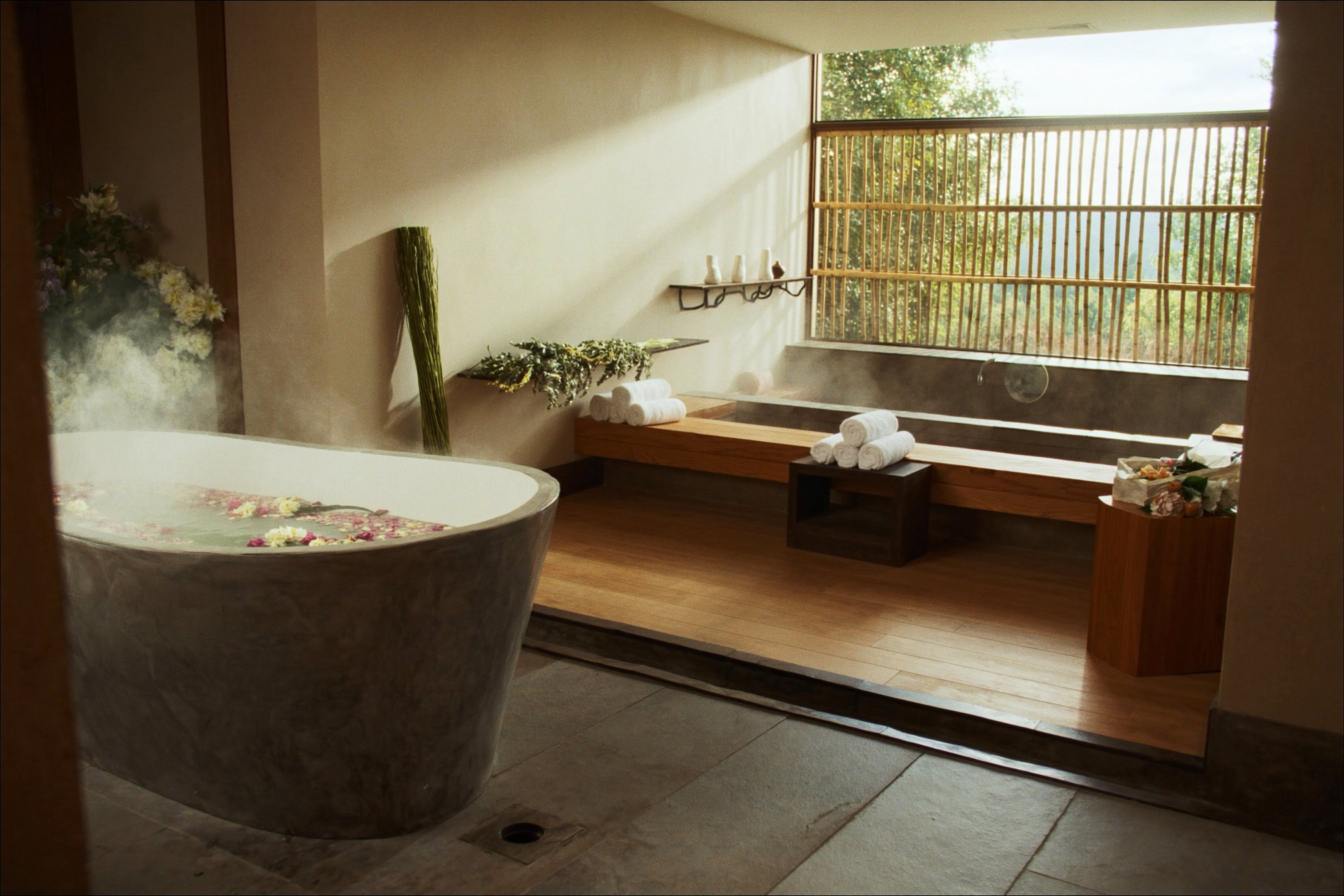
Indian Springs in Calistoga does this deliberately: the pools are kept at a temperature that forces the body to slow. The mud baths take away every accessory and leave you with only weight and heat. There's nothing accidental about what that does to people by the time they get back to the room.
You can't pipe in a geothermal pool. But you can stop treating the bedroom as a room that happens to have a bed in it, and start treating it as a room that is actually for something.
Three Things Worth Looking At This Week
1. The lighting after 9 PM. Turn off the overhead light in the bedroom for one week. Use only lamps or candles. Notice if anything changes in how quickly you wind down, how the conversation feels.
2. What's visible from the bed. Lie down and look around. What you see is what your brain processes as context. A laundry pile is context. A closed laptop is context. A lamp and a book and something on the nightstand that signals this room matters: also context.
3. The phone's default location at night. If it's on the nightstand, you already know what it's doing to your sleep and your availability to the person next to you. Sleep Is Foreplay covers this in detail, and it's worth the read before you dismiss this as obvious.
The Relationship You Want Needs a Home That Fits It
None of this is about buying things. It's about noticing what your home is already teaching you about your relationship every single day, and deciding whether those lessons are intentional.
The defaults are going to run regardless. The overhead light will go on. The TV will be the first thing you look at. The phone will end up in the bed.
Unless you change the default. Which is a small act with a surprisingly long reach.