He's on the couch with a book. You're at the kitchen table with your laptop and the rest of the wine. Nobody's talking. Nobody's performing. At some point one of you gets up to refill a glass and asks nothing, says nothing, just rests a hand briefly on the other's shoulder on the way back.
That's it. That's the whole scene. And it is, quietly, one of the more intimate things two people can do.
What Parallel Play Actually Is
Child development borrowed the term first. Toddlers who play side by side — not together, not ignoring each other, but near each other — are doing parallel play. They're learning to be in company without making demands of it.
Adults do the same thing. We just forgot it was allowed.
In a relationship, parallel play looks like: two people in the same room, doing completely unrelated things, neither anxious about the silence. One reads. One scrolls. One sketches or stretches or just stares at the middle distance with a cold cup of tea. The shared space is the point. Not the conversation. Not the activity. The shared space.
Why We Think It Means Something's Wrong
There's a script about what intimacy should look like. It involves eye contact. Directed attention. Conversation with arcs and conclusions. Quality time as a product you can hold up and examine: did we do enough of it?
When a couple sits in quiet, outsiders — and sometimes the couple themselves — read it as drift. As the relationship going stale. As two people who've run out of things to say.
Usually the opposite is true.
The couples who can do nothing together without it becoming something to fix are the ones who've actually figured something out.
— Modern Love Living
What silence requires is trust. Trust that the other person isn't bored of you specifically. Trust that you don't have to be entertaining to be worth staying near. Trust that the relationship isn't a performance that stops running the moment you stop feeding it lines.
The Micro-Behaviors That Give It Away
Parallel play done well has a texture to it. You notice the small things: the way someone angles their body slightly toward you even while looking at a screen. The background-track awareness of each other's sounds. The way you can both be fully somewhere else and still, on some frequency, know exactly where the other one is in the room.
It's not the same as ignoring each other. The difference is porousness. Ease of re-entry. Someone looks up, says something small, both of you laugh, both of you drift back to whatever you were doing. No rupture. No negotiation. No performance of transition.
Compare that to the other kind of silence: the one that follows an unresolved argument, or builds in a relationship where two people are no longer curious about each other. That silence has weight. It presses. You can feel the absence of something in it.
If you want to understand the difference from the inside, read The Silence That's Comfortable vs. the Silence That's a Wall. It draws the line more precisely than most couples know how to draw themselves.
What It Actually Takes to Get Here
Parallel play isn't a skill you practice. It's more like a threshold you cross, usually without noticing. One night you realize you've been sitting together for two hours and the time felt easy, not wasted. That's usually somewhere in year two or three, if things are going well.
Getting there requires a few things no one talks about directly. One is differentiated identity: the sense that you are still your own person inside the relationship, with interests and moods and inner weather that doesn't always include your partner. The couples who can't do parallel play are often the ones who merged too fast — where time apart began to feel like rejection, and time together became the only proof the relationship existed.
The other thing it requires is settled attachment. Not the absence of anxiety, exactly. More like enough evidence, accumulated over time, that the relationship can hold a quiet evening without it meaning something's broken.
The Wine Country Version of This
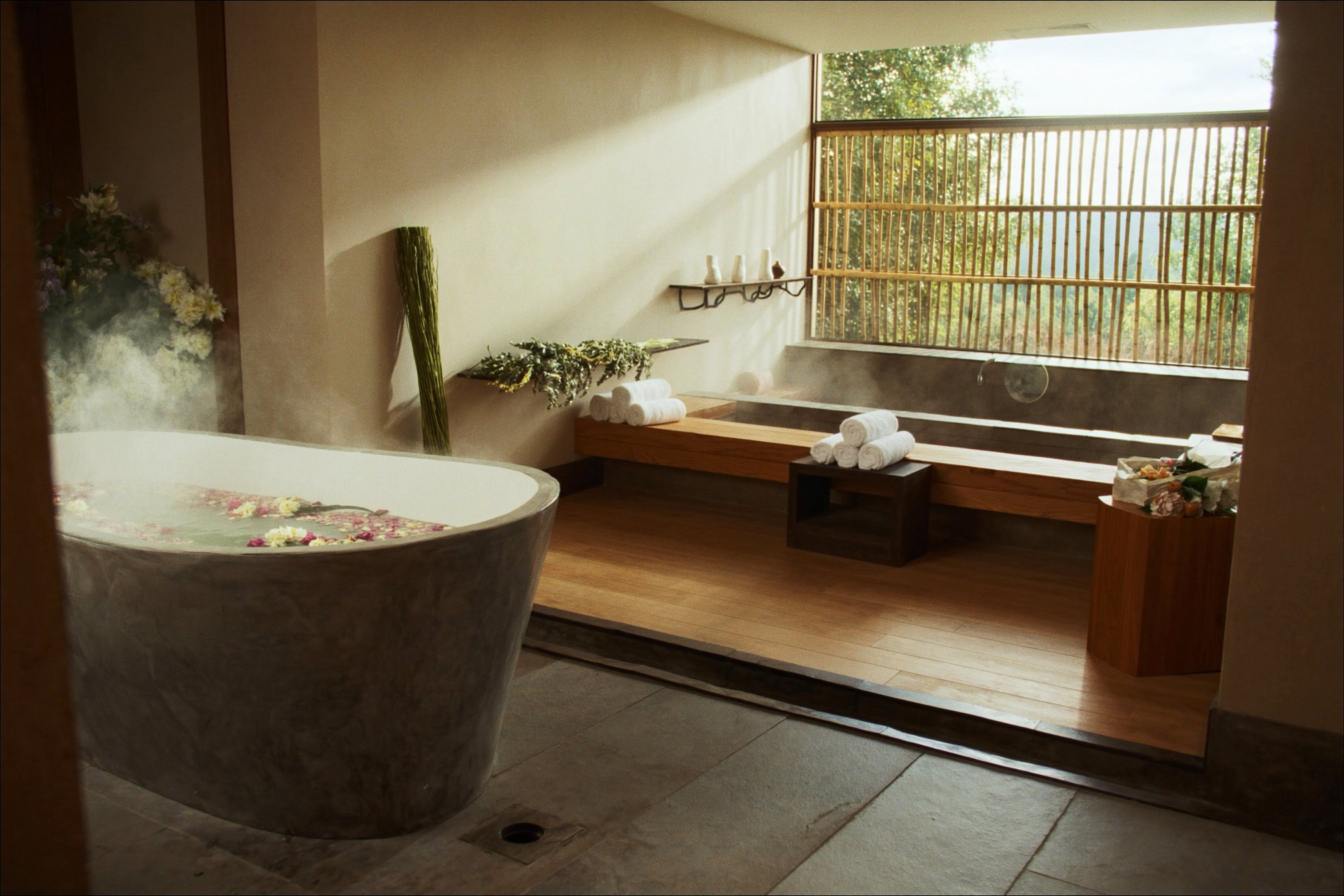
There's a particular version of parallel play that happens at Solage in Calistoga — two people at the bathhouse, side by side in the mineral pools, not talking, not needing to. Or on the back porch of a rental in Healdsburg on a Sunday morning: one person reading, one person doing the crossword, a pot of coffee between them on a wrought-iron table, the sound of someone mowing somewhere far away.
It sounds like nothing. It is nothing. And for the couples who can live inside it without itching to fill it, that nothing is a kind of luxury — earned, not purchased.
When Parallel Play Starts to Slip
There's a version of this that goes wrong. It's worth naming.
If parallel time becomes the only time — if it's been weeks since the two of you were actually present with each other, fully oriented toward each other — it's stopped being ease and started being avoidance. The room is shared but the relationship is running on autopilot.
The signal isn't the silence. It's what happens when you try to leave it. If reaching for actual conversation feels effortful, rusty, slightly foreign: that's information. Not crisis, necessarily. But worth paying attention to.
The five-minute check-in is one way back in. Not a formal thing. Just: eyes up, phones down, actual question, actual answer. Something small that re-establishes the current between two people.
The Permission Slip
Here's the thing most couples have never been explicitly told: you do not have to be entertaining your relationship at all hours to be in a good one.
You're allowed to be in the same room and somewhere else. You're allowed to finish a thought before you surface. You're allowed to not perform presence while still being present.
The couples who do this well have usually, at some point, stopped measuring the relationship by its output. By how many good conversations they had this week. By whether they did enough dates, enough check-ins, enough of the things that look like intimacy from the outside.
They've started measuring it by how it feels to just be somewhere together. Whether the house is easy. Whether the quiet has a floor.
That's the whole of it, really. Two people. Same room. Different things. Nobody performing. The lamp on, the wine poured, and somewhere underneath all the nothing: the particular warmth of a relationship that doesn't need to prove itself tonight.