At some point you started calling it self-care and stopped actually doing it. The spa gift card expired. The bath bombs dried out in the cabinet. The meditation app sends you guilt notifications three times a week. You are not relaxed. You are just more aware of how unrelaxed you are.
Here's what nobody says out loud: the stuff that actually repairs your nervous system is almost always embarrassing to admit. It's not photogenic. It doesn't belong on a mood board. And it is completely, specifically yours — which is exactly why it works.
Why the Spa Version Doesn't Land
A hot spring soak at Indian Springs or an afternoon at Solage — those are genuinely good. But they work because of the conditions: you've cleared your schedule, you're not checking your phone, someone else is managing the logistics. The water is doing maybe fifteen percent of the work. The rest is the permission you gave yourself to stop.
Most of us can't manufacture that on a Tuesday. So we don't. We tell ourselves we'll do it properly later, when there's more time, when things calm down. Later doesn't come. Things don't calm down.
The nervous system isn't waiting for optimal conditions. It's just waiting for a signal that the threat has passed. You can send that signal in your own living room. It just requires knowing what your specific signal actually is.
What 'Deeply Specific' Means Here
One person's reset is three episodes of a show they've already seen, eaten on the couch in a robe, no text replies until it's over. Another person's is driving a backroad with no destination and music that's slightly too loud. Another is forty minutes of cooking something elaborate and fussy that no one else will eat.
These have almost nothing in common on the surface. What they share: low stakes, no performance, full attention on one small thing, and a body that gets to just be a body for a while.
The Real Shape of a Two-Hour Reset
It starts with your phone in another room. Not face-down on the table. Another room. The body needs about fifteen minutes to stop bracing for it.
Then: whatever your version is. The specificity is load-bearing. Vague rest doesn't work. 'I'm going to relax this afternoon' produces nothing. 'I'm going to make that pasta, drink one glass of something cold, and sit outside until the light changes' produces a person who actually feels different afterward.
The body responds to sensory specifics. The weight of a heavy robe. Oil that smells like something you actually like, not whatever came in the gift set. Heat on the back of your neck. These aren't luxuries — they're inputs your nervous system uses to decide whether you're safe right now.
What This Has to Do With Your Relationship
A dysregulated nervous system makes you a worse partner. Not morally. Physiologically. You misread tone. You run out of patience before the conversation needs you to have any. You are physically present and functionally somewhere else — usually somewhere tense, reviewing the list.
That's not a character flaw. That's a body that hasn't had two hours to itself in longer than you'd care to admit.
Rest that actually works is rest that your body chooses, not rest that looks correct on a wellness checklist.
— MLL Editorial
The article Sleep Is Foreplay gets at this from the desire angle. But the same logic applies to the rest of the day. A body that's been running on cortisol since 7 a.m. is not a body that's available — for touch, for conversation, for any of the things that make a relationship feel alive.
The Unglamorous Part
You might spend your two hours reorganizing something small that's been bothering you. A drawer. The streaming queue. The way the pantry is arranged. This is completely valid nervous-system regulation. It doesn't look like healing. It looks like a person who cares too much about where the pasta goes. The distinction is whether you feel better after. If yes, it counts.
You might read something stupid and easy and finish the whole thing. You might take a walk with no intention of it being good exercise, just motion for motion's sake. You might sit somewhere with a warm drink and do genuinely nothing for twenty minutes, which will feel unbearable for the first eight and then gradually become the thing your whole body was asking for.
How to Actually Protect the Time
The afternoon has to be blocked on a calendar or it will be eaten. Not 'blocked off' with air quotes and a vague intention. Actually blocked. Treated with the same defensive energy you apply to a dentist appointment you had to wait three months to get.
Tell your partner. Not to ask permission. To make the boundary concrete. 'Tuesday from 2 to 4 is mine' is harder to erode than a plan you only made with yourself.
If you have kids, the logistics are harder and you already know that. The point stands. Even ninety minutes, scheduled and defended, is enough to send a different signal than the one your nervous system has been receiving.
Questions People Actually Have About This
Isn't this just another word for self-care?
The word is fine. The version of it that got sold to you — the one with the branded bath salts and the gratitude journal and the routine that's actually another performance — that version doesn't work for most people. This is simpler: two hours, your rules, the specific thing that actually does something for your body. Call it whatever you want.
What if I don't know what my specific thing is?
Think back to the last time you felt genuinely okay — not happy, just okay. Unbraced. What were you doing? Where were you? What were you not doing? Start there. It's usually quieter and more ordinary than you expect.
Does this have to be solo?
Not necessarily. But it has to be low-performance. An afternoon with someone where neither of you is managing the other person's experience — where you're both just doing something easy and parallel — can absolutely count. The problem with company is that it often adds the weight of being present for someone else. If it doesn't, you're fine.
The Afternoon Is Already There. You Just Haven't Taken It.
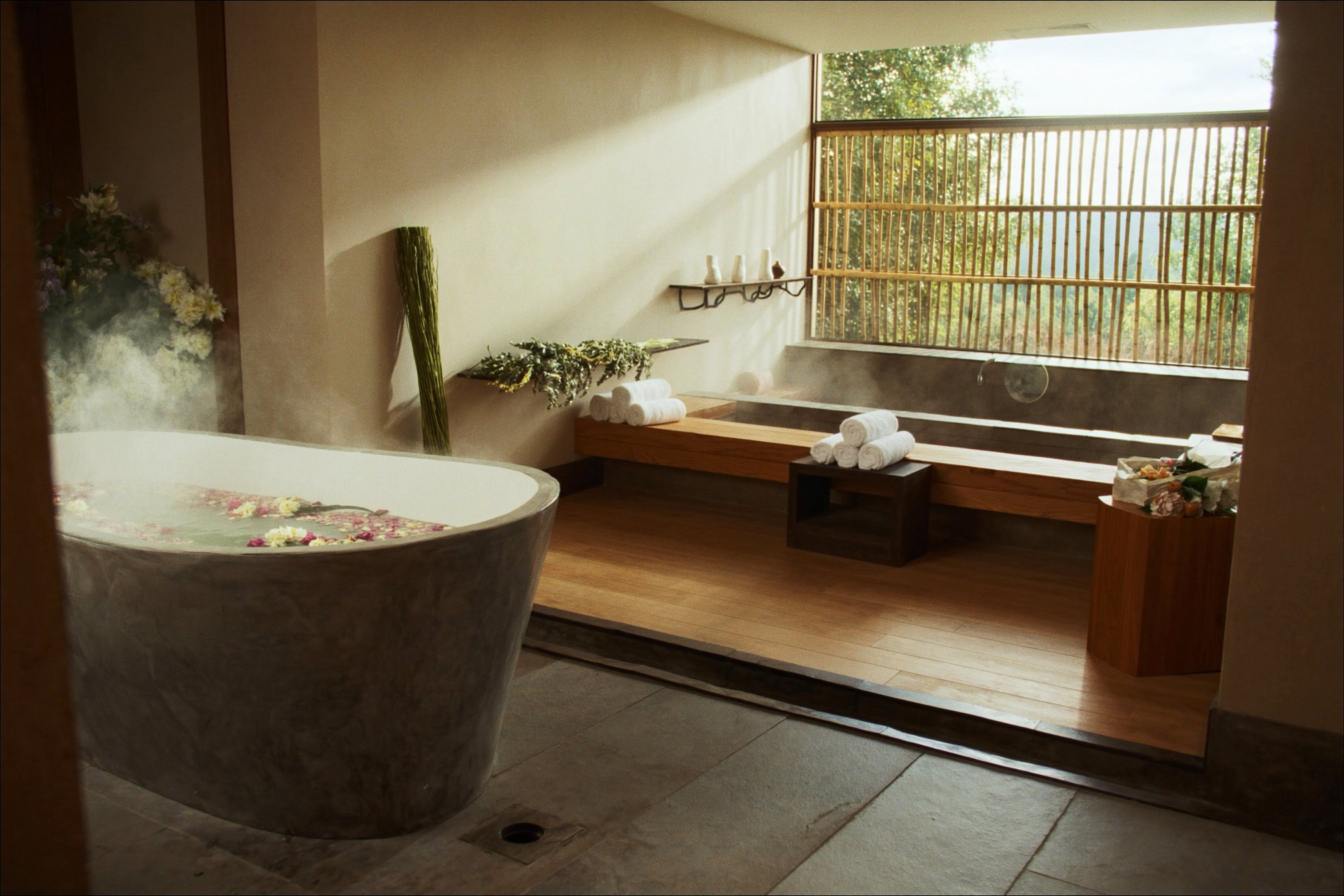
It doesn't require a drive to Healdsburg or a booking at a place with stone floors and warm towels. Those are nice. They're not the only access point.
The access point is deciding — actually deciding — that two hours of unglamorous, specific, slightly embarrassing reset is worth defending. Not earning. Not rewarding yourself with. Just taking, because a body that never gets to stop is one that starts sending the signals in other directions: irritability, distance, numbness, the low-grade hum of being perpetually almost-okay.
You already know what your version looks like. You've done it before, accidentally, on a day when things fell through and you suddenly had time. You remember how you felt at the end of it.