You walk into a restaurant and before you sit down, you already know: table near the window is too visible, that guy at the bar clocked you, the couple in the corner won't be a problem. You did all of that in four seconds. You didn't decide to. You just did.
This is not paranoia. This is a skill. You built it young, probably without anyone naming it, and it has kept you safe in hallways and parking lots and family kitchens and gas stations in the wrong county. It is also, quietly, exhausting your body from the inside.
What the room-read actually costs
The nervous system doesn't distinguish between a genuine threat and a perceived one. It reads the same signal either way and responds accordingly: heart rate up, breath shortened, muscles slightly braced. When you scan a room, your body is preparing to respond.
Do that enough times across enough years, and the braced state stops being a response. It becomes the baseline. Not dramatic. Not a breakdown. Just a low hum of readiness that never fully powers down.
Some people call this hypervigilance. That word makes it sound clinical and extreme. It's usually neither. It's just being a person who learned very early that safety is conditional — that it applies or it doesn't depending on who's watching and what they see.
Safety is conditional. Most queer people figured this out by eleven. The body remembers even when the mind has moved on.
When the danger is gone but the bracing stays
Here's where it gets complicated. You may have built a life that is genuinely safe. Partner who loves you. Apartment that's yours. Friend group that would fight for you. And still, some part of you holds. Still scans. Still prepares.
This isn't a failure to heal. It's biology doing what it was trained to do. The nervous system learns from repetition, not resolution. It doesn't receive a memo that the town you grew up in is four states away now.
It shows up in small things. The way you pull your hand back in a crowded market before your partner even notices. The way intimacy sometimes requires a strange internal negotiation before your body agrees to be present. The way you're never quite fully relaxed in a room where you haven't done the read yet.
What this looks like inside intimacy
Bed is supposed to be the place where the read stops. For a lot of queer people, it doesn't. Not entirely.
There's a particular kind of friction that doesn't come from incompatibility. It comes from one person trying to be present and another part of them still watching the door. You can want to be fully there — want it completely — and still feel the distance between your actual skin and wherever your attention went.
Partners feel it too, even if they can't name it. There's a difference between someone who's with you and someone who's almost with you. The almost is not about desire. It's about safety that hasn't finished arriving.
This is adjacent to what we covered in minority stress doesn't clock out when you get home — the idea that the weight you carry in public doesn't evaporate the moment you close your own door. It follows you in. Sometimes it gets into bed with you.
Why relaxing feels like risk
Full relaxation is full exposure. No scan running, no exits noted, nothing braced. For a body that learned exposure equals danger, the instruction to just relax lands like a small absurdity.
This is the thing that well-meaning advice almost always misses. It tells you to be present, to breathe, to let go. As if letting go is a choice you simply haven't made yet. As if you've been holding on for fun.
Relaxation has to be earned by the nervous system, not announced to it. And the earning is slow. It happens in small accumulated moments of: nothing bad happened here. And here. And here again.
What actually helps (and what doesn't)
Talking about it helps, but only up to a point. At some threshold, this stops being a conversation problem and becomes a body problem. Language lives in the cortex. The bracing lives somewhere older.
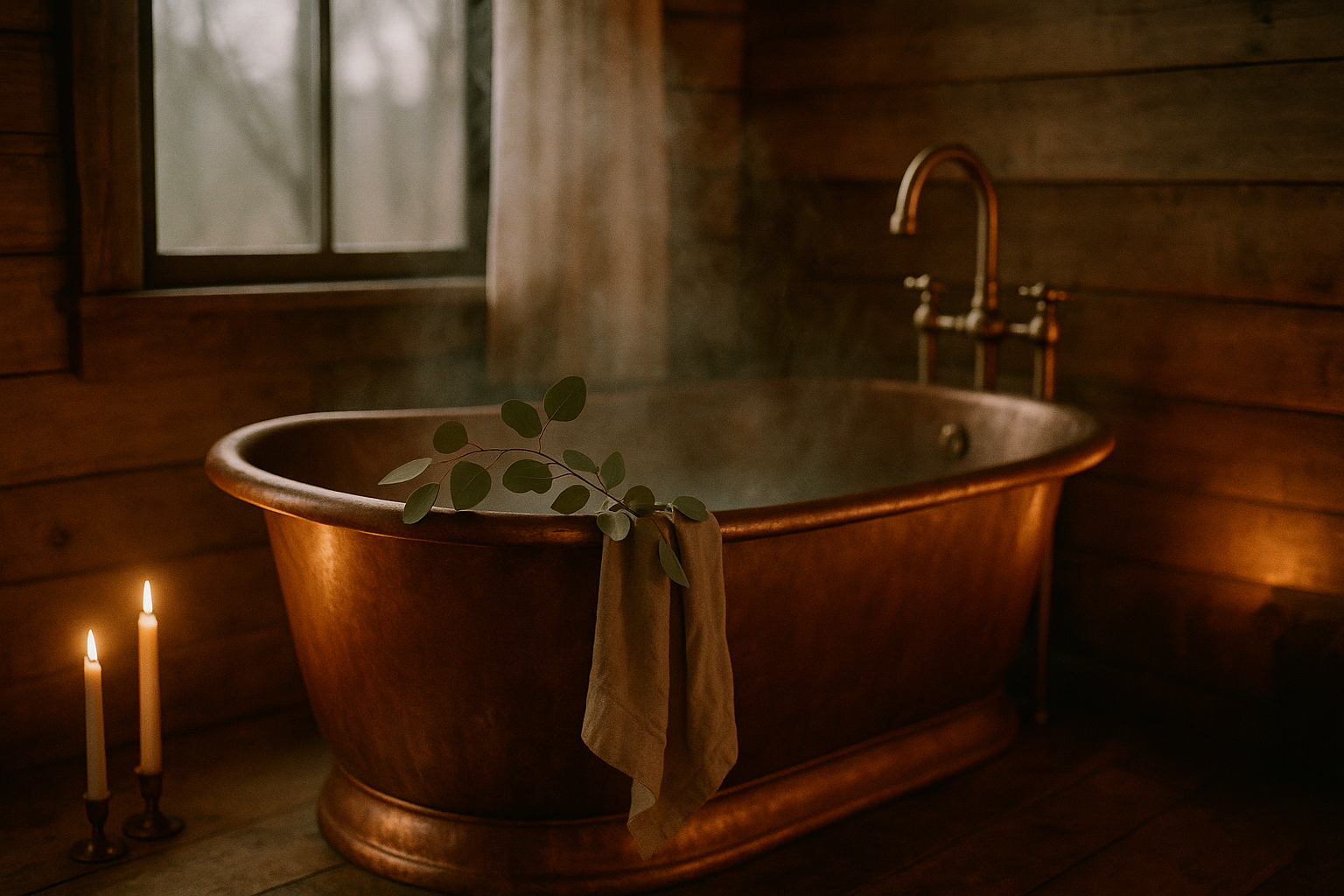
What actually reaches it: repetition of safe sensation. Heat is one. A long bath, the weight of warm water on skin, steam that makes the room soft — not because it's a spa cliché but because warmth signals the nervous system directly. Not through thought. Through skin.
Weight helps too. A heavy blanket, a partner's actual body, the warm pressure of a hand on a shoulder that stays there long enough to register. These aren't remedies. They're evidence the body can collect.
Slow touch without agenda is something different from touch that leads somewhere. Both matter. But the kind that's only warmth — oil worked into a shoulder, fingertips without direction — teaches the body that contact can arrive without needing to be evaluated.
Safe places do something real
Geography matters more than we admit. There are places where the room-read softens, where you drop a layer you didn't know you were wearing. A long weekend in a place where nobody's watching — a rented house in the Dry Creek Valley, a slow afternoon at Solage where the only social contract is: you are not required to explain yourself — that isn't indulgence. It's data collection for your nervous system.
The Healdsburg plaza on a Wednesday, mostly empty, wine open, nobody performing anything: there's a particular quality of unguardedness that accumulates there. If you've felt it, you know. It doesn't fix anything. But it gives your body a reference point. This is what no-scan feels like.
You can use that. Not just as a vacation, but as evidence. The body was relaxed. The body survived the relaxing.
What you might say to a partner
Not this: I have hypervigilance from years of navigating hostile environments and it affects my capacity for intimacy. True, but it creates distance right when you're trying to close it.
Maybe this instead: Sometimes I need a minute to land. It's not about you. It's just — I come in a little braced. Give me a few minutes in the quiet and I'll actually be here.
That's enough. It names the thing without turning the conversation into a case study. Partners can work with that. They can give you the quiet. They can not take the distance personally, if you tell them it isn't personal.
The piece on coming out again, quietly: identity in long relationships touches this from a different angle — the way queerness keeps revealing itself inside relationships, in new ways, at new depths. This is one of those ways.
This doesn't go away. It goes quieter.
There's no version of this where the skill disappears. You're not trying to stop reading rooms. You built that skill in conditions that required it and it belongs to you.
What changes is the authority it has. Right now, for a lot of people, the scan is the first voice and the loudest one. Over time, with enough evidence, it becomes one voice among several. Still present. Less in charge.
That's not a small thing. That's actually the whole thing.
Your body did what it had to do to keep you here. The work now is giving it enough safe moments that here starts to feel like somewhere it can actually rest.