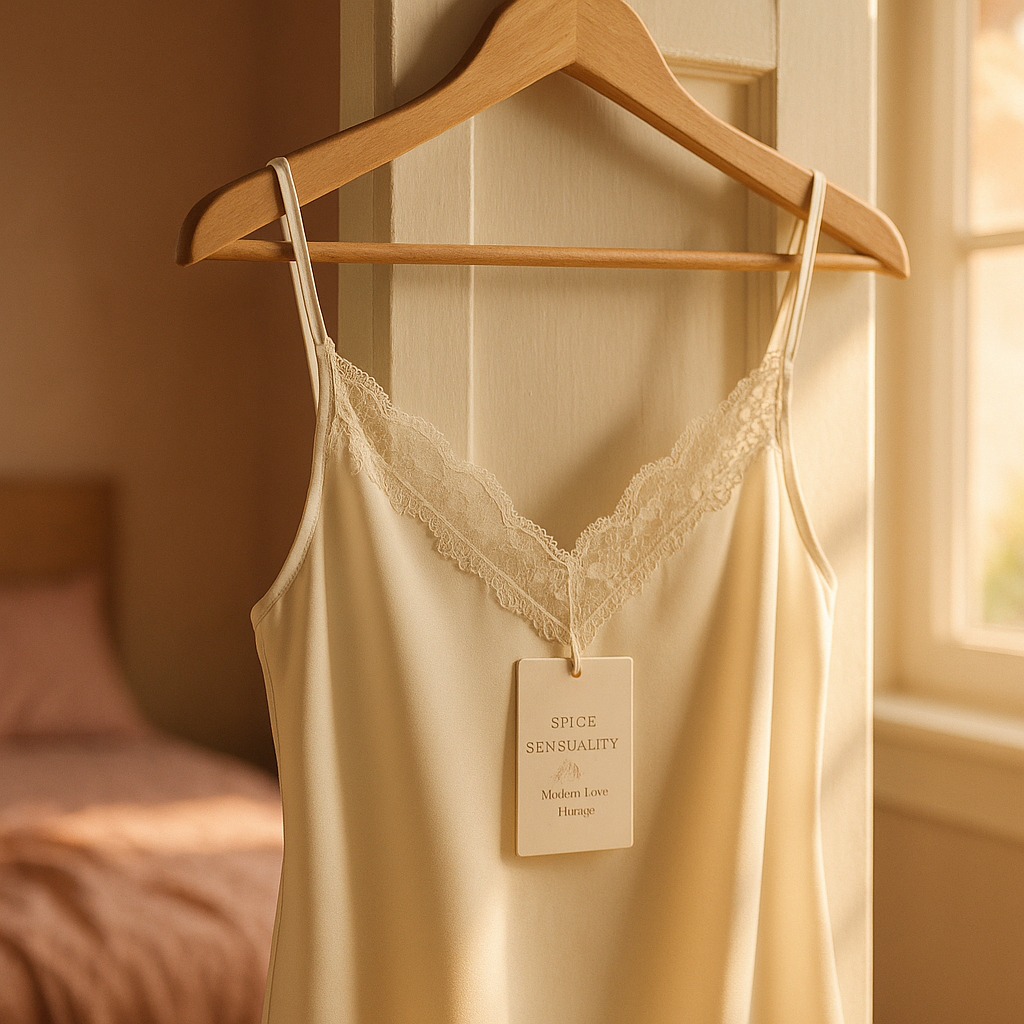
There's a version of you that exists at 9 PM on a Thursday when nobody's watching and nothing is required. You've changed out of the day. You've made a small, private choice about what goes against your skin. And something shifts — not dramatically, not in a way you could explain out loud — but your shoulders drop differently. You take up slightly more space.
That's not magic. That's fabric doing what fabric actually does when you let it.
This Isn't About Anyone Else Noticing
The cultural conversation around lingerie and luxury fabric defaults immediately to the gaze. Who's going to see it. Whether it photographs well. Whether it reads as desirable to someone across a room.
That framing misses almost everything real about why the right thing against your skin matters.
The shift is proprioceptive. It's happening in your nerve endings, not in anyone's eyes. Silk against the inside of your wrist feels different from cotton. Heavy satin on your hips carries differently than something soft and unstructured. Lace along your ribs is a continuous, low-level reminder that you made a specific choice tonight.
What's Actually Happening Beneath It
Your nervous system is absorbing information constantly. The weight of a robe. The temperature of silk warming to your skin. The faint resistance of elastic sitting precisely where it's supposed to. These aren't aesthetic details — they're tactile signals that compound.
When those signals are boring or uncomfortable or just default, you move through a room like someone who's on autopilot. Efficient. Forgettable to yourself.
When they're intentional — when you put on something with a slight sheen, or a hem that grazes your thigh differently, or something that sits against your sternum with just enough weight — your body registers it. You become slightly more awake to yourself. That aliveness reads in how you walk. How you reach for things. How you inhabit a conversation.
I didn't realize how much I'd been moving through my evenings like furniture until I put on something that actually fit what I wanted to feel like. Nobody saw it. That wasn't the point.
— MLL reader, 34
The Specific Fabrics and What They Do
Silk and Charmeuse
Silk is temperature-responsive. It starts cool and adjusts to you. That initial contact — the slip of it against warm skin — is sensory information that lands before your brain has fully formed an opinion. It doesn't perform. It just responds. Charmeuse has more drape and a slight liquid weight that changes how your body registers its own movement.
Lace
The function of lace is tactile interruption. Not decoration. The pattern of it creates micro-sensations against skin that are intermittent, specific, and impossible to ignore in a quiet way. It keeps you aware of a particular edge of your body without demanding your full attention. That low hum of awareness is the point.
Satin
Heavier than it looks. That weight on your hips, or across your chest, changes your center of gravity in a way that makes you move more deliberately. Satin doesn't rush. If you're wearing it, you don't either.
Ribbed Cotton and Jersey
Worth including because intention works with any material. There's a specific kind of confidence in a ribbed tank and nothing else at 10 PM — the signal to yourself that you've decided tonight is unhurried and entirely yours. The fabric doesn't have to be expensive to carry meaning.
The Night It Actually Works
Picture it plainly. You're getting ready for an evening that matters to you — maybe it's a dinner at home you've decided to take seriously, maybe it's the beginning of a night you've been thinking about. You shower. The bathroom still has steam. You reach past the practical thing and put on the slip you haven't worn in three months.
It's silk. Or close to it. It hits mid-thigh and it's slightly cold for the first thirty seconds. Then it's not. And you stand in front of the mirror for a moment — not performing, just checking — and something about the way you're standing is different.
You walk out of the bathroom and you move differently down the hall. Not for anyone watching. Just because your body got the memo that tonight you're being intentional about who you are.
That's it. That's the whole mechanism.
Why the Matching-Who-You're-Trying-to-Be Part Matters
The phrase "who you're trying to be that night" isn't abstract. Some nights you're trying to be soft. Some nights you're trying to be deliberate. Some nights you want to be someone who takes up space unapologetically, and some nights you want to be someone curled up and unhurried.
The fabric you put on is a small, private vote for that version. It's not a costume. It's more like a commitment device: something external that makes an internal intention a little more real.
This connects directly to what dressing-for-the-version-of-yourself-youve-been-ignoring and lingerie-for-the-mirror both circle around: that the most significant audience for how you present yourself is often you. Particularly when desire or confidence has gone quiet.
When You're Not Doing It Alone
The private shift in how you carry yourself is yours first. But it does translate outward.
Partners notice changes in how you move before they notice what you're wearing. The slightly slower way you cross a room. The fact that you seem more present in your body. The way you reach for a glass of wine with something that reads like ease instead of habit.
That presence — that being-more-awake-to-yourself — is what actually changes the temperature of an evening. Not the fabric specifically. The fabric was just the starting point.
If you've been in the kind of long-term dynamic where desire has become efficient and routine, a small tactile choice can break pattern without requiring a conversation about it. It's a quiet re-entry into your own body. Partners who are paying attention will feel it before they can name it.
The Practical Shift
This isn't a shopping recommendation. It's simpler.
Identify one thing already in your possession that you reach past out of habit — the thing you're saving for some undefined later. Wear it on an ordinary weeknight. Not for an occasion. For a Tuesday. Notice whether your body responds to the choice.
That's the experiment. That's where this starts.
The version of you who moves differently through the room at 9 PM on a Thursday isn't a special occasion version. She's available whenever you make the small, specific, skin-level decision to call her in.