You lie on the couch at 7 PM and can't make yourself move. You had things to do. You had things you wanted to do, theoretically. But the wanting itself has gone flat, like a drink you left sitting too long. So you scroll. Not because it's good. Because everything else requires a spark you can't locate.
This is what we call laziness. And it's almost never that.
The Diagnosis Is Wrong
Laziness implies a choice. A preference for stillness over effort. But most people lying on that couch are not choosing rest. They're exhausted in a way that sleep doesn't fix, understimulated in the ways that count, and overstimulated in the ways that drain.
They've been in back-to-back calls that required performance. They've managed other people's feelings, held their own in, and kept their face neutral through seventeen things that deserved a real reaction. They've eaten lunch at a desk and called that a break.
The couch at 7 PM isn't laziness. It's the body finally saying: I've been on since 6 AM and nothing I did today actually fed me.
What Under-Stimulation Actually Feels Like
It doesn't feel like boredom, exactly. Boredom has a restless edge. This is flatter than that.
It feels like reaching for something and finding the shelf empty. Like starting three sentences in your head and abandoning all of them. Like standing in front of an open refrigerator — not hungry, not full, not sure what you're looking for.
In relationships, it looks like not initiating. Not because you don't want connection, but because the circuitry that generates the impulse is temporarily offline. Your partner interprets it as disinterest. You interpret it as something being wrong with you. Neither of those is accurate.
Desire — physical, creative, relational — requires a nervous system that isn't already running at capacity. When the system is flooded with low-grade stimulation all day, the higher registers go quiet. Not gone. Quiet.
The Scroll Is the Symptom
Here's the part that stings a little. The phone isn't helping.
It feels like rest because it requires nothing. No performance, no output, no sustained attention. But it's not rest in any physiological sense. It's a low-grade stimulant that keeps the nervous system just activated enough to not relax, while delivering zero of the input that actually restores.
An hour of scrolling is like eating sugar when you're starving. It occupies the hunger without addressing it. You put the phone down feeling vaguely worse, vaguely more empty, and no closer to whatever it was you actually needed.
Real rest is not the absence of stimulation. It's the presence of the right kind.
— MLL
The Right Kind of Stimulation
There's a specific texture to the things that actually restore. They tend to be physical, unhurried, and slightly sensory. They don't ask you to produce anything.
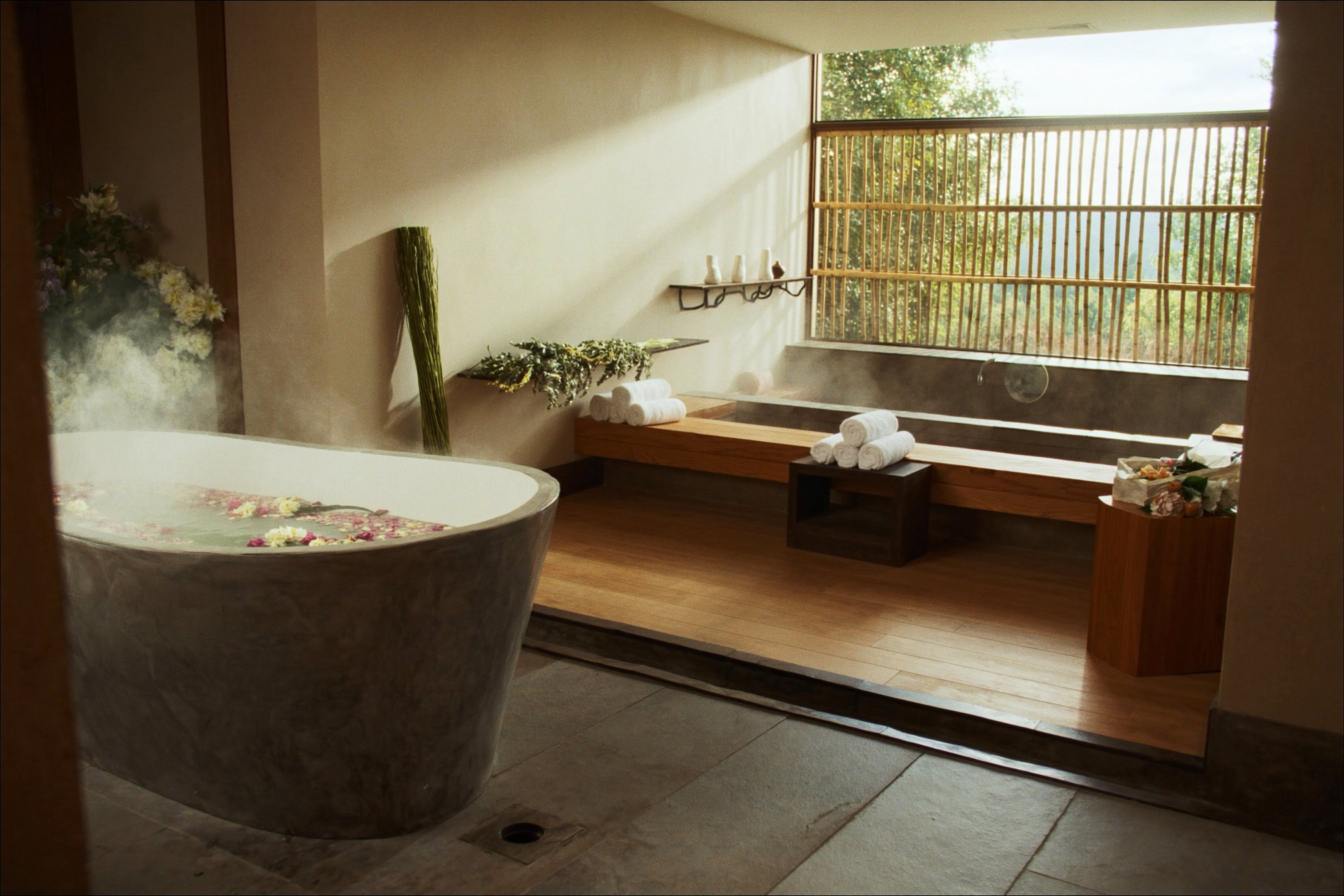
Walking without a podcast. Cooking something that takes twenty minutes and smells good. Sitting outside in the early evening when the light is doing something interesting. A bath where the water is actually hot. The weight of a heavy robe after.
In Healdsburg, there's a particular kind of afternoon that does this work automatically. The plaza is slow. The light through the oak canopy is dappled. You sit with a glass of something cold and there's nowhere to be and nothing to monitor. Most people spend the first hour fidgety. Then something releases.
That release is not a luxury. It's the system returning to a state where desire can fire again. Where you look at the person across from you and actually see them.
Where Desire Fits Into This
Physical desire and motivational desire run on the same infrastructure. This is not a metaphor. The dopamine pathways that make you want to pursue a project, call a friend, or try something new are the same ones that make you want to touch your partner.
When people describe going through a low-desire period, they often describe it as total: not just sex, but creativity, appetite, ambition. Everything goes a little grey at once. That's not a coincidence, and it's not a character flaw.
It's a system that's been asking for something different for a while and has stopped asking as loudly.
Boredom Is Not the Enemy
We treat boredom like a failure state. Something to be solved immediately, preferably with a screen. But boredom is actually the first stage of recovery from over-stimulation. It means the noise has quieted enough that you can feel the absence.
If you sit with it instead of fixing it, something interesting tends to happen. The restlessness builds, and then crests, and then a real want surfaces. Not a craving for stimulation, but an actual desire. For a person, a project, a place, a conversation you haven't had yet.
Children who are allowed to be bored invent games. Adults who are allowed to be bored often find their way back to the things they stopped doing because they ran out of time and energy. The canvas in the corner. The body they've been passing through instead of living in.
What to Actually Do
Not a list. A single honest suggestion.
Find one hour this week with no input and no output. No podcast, no phone, no task. If you're in a relationship, this works better with another person present and also doing nothing. Lying in bed in the morning before anything starts. Sitting on a porch. Walking somewhere slow.
The boredom will show up first. That's correct. It means it's working.
Then, if you let it run, something warmer usually follows. A hand that reaches for someone else's. A thought worth saying out loud. A small, specific want that had been waiting patiently in the back of the room.
That's not laziness recovering. That's you.
Related reads: Sleep Is Foreplay explores how rest directly affects desire. Desire That Went Quiet Isn't Gone goes deeper on what happens when wanting disappears. Why Rest Feels Selfish is about the guilt that makes this harder. And if the flat feeling has a relationship underneath it, The Resentment You're Calling Boredom is worth a look.