You got eight hours. You canceled the thing you didn't want to do. You even had a slow Sunday with coffee and nowhere to be. And Monday morning you're still hollow. Still behind your own eyes in a way that doesn't feel like tired so much as used up.
You've probably already Googled iron levels. Thyroid. Cortisol. And maybe one of those is worth checking. But there's a version of this exhaustion that no blood panel will catch, because it isn't living in your body. It's living in your relationships — and in the invisible work you do inside them, every single day.
Two Kinds of Tired That Feel Identical
Physical fatigue responds to rest. You sleep, you recover, you feel it lift. Emotional depletion doesn't work that way. It accumulates in a different register entirely: in the calculations you run before you speak, in the moods you absorb and metabolize for other people, in the version of yourself you perform so that the room stays okay.
The tricky part is that your body doesn't distinguish between them. Both feel like weight. Both feel like drag. So you keep trying to sleep your way out of something sleep was never designed to fix.
What's Actually Draining the Tank
The anticipation tax
There's a specific exhaustion that comes from bracing. From knowing someone's mood when they walk in before they've said a word. From reading the silence at dinner and running the odds on whether to say something or let it pass. That's not rest-able fatigue. That's your nervous system running a background process it can never close.
Chronic under-reciprocation
You notice what people need. You adjust. You smooth things over. You reach first, offer first, soften first. And the other person isn't cruel — they're just not doing it back. Over time, that asymmetry becomes its own kind of drain. Not dramatic. Just slow, consistent, and very hard to name without sounding like you're keeping score.
If you've spent time with the idea in vulnerability debt, this is its physical manifestation. The lopsided disclosure lives in your chest eventually.
The performance of fine
There are relationships where you can say I'm not okay and it lands softly. And there are relationships where saying that requires a whole infrastructure: the right moment, the right framing, the read on whether they can handle it right now. The second kind costs something every time. Even when you don't say it.
Ambient conflict you've stopped naming
A fight you never finished. A pattern you've spotted but agreed not to see. The thing under the thing you keep having the same argument about. It doesn't have to be loud to be exhausting. Low-grade relational friction hums constantly, and you habituate to it the way you habituate to noise — until you can't sleep in silence anymore.
You can get very good at carrying something and still be destroyed by the weight of it.
— MLL
Where It Lives in the Body
Emotional depletion isn't metaphorical. It has a physical address. It's the shoulder tension you only notice in the shower. The way you breathe slightly differently when you're home versus when you're somewhere else. The way your jaw unclenches the moment you close the bathroom door.
Your body keeps the relationship score, and it keeps it accurately. More accurately, sometimes, than your conscious assessment.
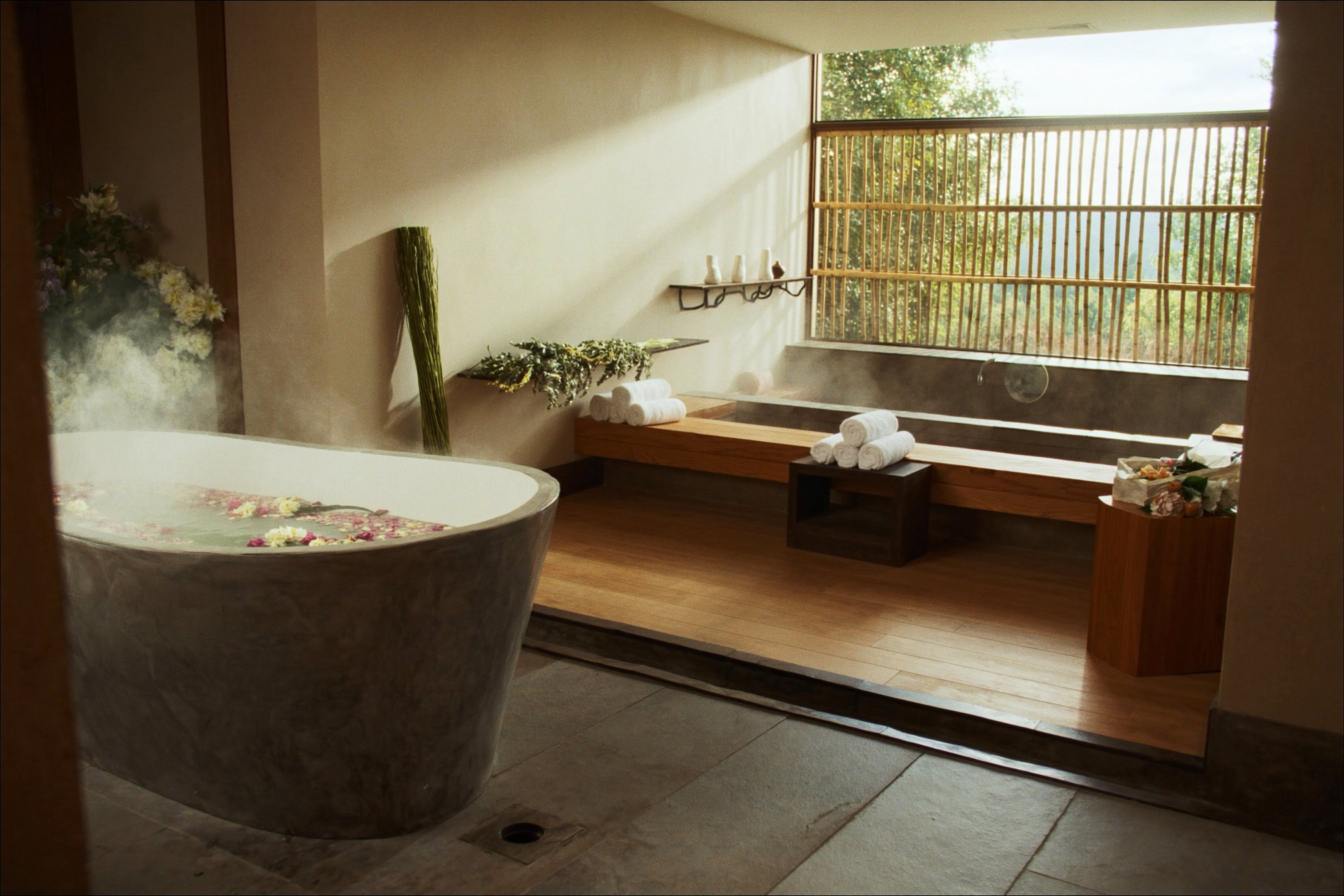
A weekend at Solage — the mineral pools, the heat, the specific silence of geothermal water — doesn't fix anything permanently. But the contrast it creates can be diagnostic. If you feel your whole system exhale the moment you cross into that kind of space, take note of what you're actually exhaling from.
The Relational Patterns Worth Examining
You don't need a crisis to be drained by a relationship. The slow-leak version is harder to catch precisely because there's nothing to point to. Nobody did anything wrong. It just costs more than it gives back, and has for a while.
Some patterns worth sitting with honestly:
The shape of your Sunday nights. Relief or dread? That one question is load-bearing.
Who you recover around. Some people refill you. Some deplete you at the same rate as being alone. Some actively cost more than the interaction was worth. That's data.
What you're monitoring constantly. A partner's tone. A friend's disappointment threshold. A parent's needs. If your attention is always on someone else's emotional state, your own goes unattended. That's not noble. It's expensive.
The conversations you're carrying unfinished. Every unsaid thing takes up real estate. Not forever, but for now.
What Actually Helps
Not a bath. Not a face mask. (See: self-care isn't the bath, it's the boundary, which is exactly what it sounds like.)
What helps is reducing the output, not increasing the recovery. That means fewer bracing moments, fewer unfinished conversations, fewer relationships where you're the only one managing the temperature of the room.
It also means getting honest about rest as a concept. Rest isn't passive. It's the active absence of performance. An afternoon where nobody needs anything from you, where you're not monitoring anything, where you can exist in your own nervous system without an agenda. That's the thing most people haven't had in longer than they can remember.
A slow drive through the Sonoma backroads with the window down and no particular destination isn't indulgence. It's system reset. Alone, ideally. Or with someone whose silence doesn't require interpretation.
One Honest Question to Start
You don't have to audit your entire life today. But there is one question worth asking: When did I last feel genuinely restored, and what was present — or absent — that made it possible?
The answer usually isn't a supplement or a sleep cycle. It's a name. Or the absence of one.
That's where you start.