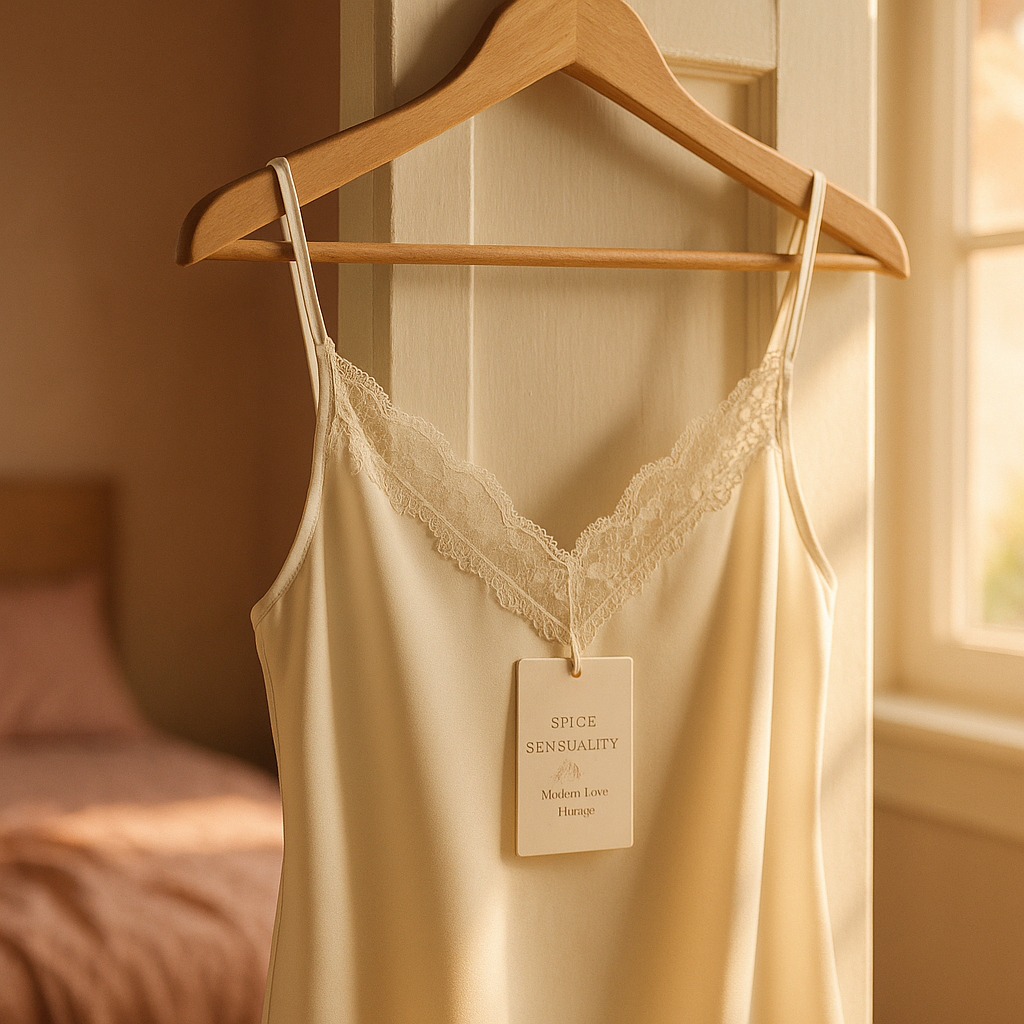
There's a piece in your drawer you don't wear for anyone. You put it on when you need to feel like a different version of yourself is available to you.
Not sexier. Not more attractive. Just. Different. Like you solved for a variable nobody else knew was in the problem.
This is about that piece. And what it actually does.
The Mirror Comes First
We talk a lot about lingerie in the context of someone watching. The reveal, the reaction, the choreography of being seen. But the moment that actually matters — the one that changes your evening, your week, your posture in a meeting two days later — happens before any of that.
It happens when you're alone with the mirror.
You close the bathroom door. You put on the silk slip or the high-waisted set or the robe with the weight that feels like it has an opinion. And something in your spine rearranges. Quietly. Without fanfare.
That rearrangement is the whole point.
What Transformation Actually Feels Like
It's not confidence in the motivational-poster sense. It's something narrower and more useful: the sensation that a different set of options just opened up.
The woman who wears the bralette under her blazer to a difficult meeting isn't wearing it for anyone in the room. She's wearing it as a private contract with herself. A reminder that she contains registers nobody in that conference room has access to.
This is different from dressing to attract. Attraction is outward-facing. This is inward architecture. You're not trying to change how anyone else reads you. You're changing how you read yourself.
The Pieces That Do This Well
Not everything works. You probably already know this. Some pieces feel like a costume. Some feel like armor. The ones that actually transform you have a specific quality: they're physical before they're visual.
The weight of a good robe against the back of your calves. The way a well-cut slip sits on your collarbones, cool and deliberate. The particular tightness of a corset-style waistband that makes you breathe differently — not uncomfortably, but intentionally. Your body notices, and adjusts.
It's sensory before it's symbolic. The symbolism comes after, once your nervous system has already taken the note.
Why We Underestimate This
We've spent so long framing intimate dressing as performance — as something you do for a partner, for a date, for a camera — that the solo version feels somehow lesser. Like it needs to be justified by an audience.
It doesn't.
The woman who slips into something beautiful at a spa in Calistoga, alone for the weekend, and spends twenty minutes just drinking coffee in it — not performing, not waiting for anything — she's not doing a lesser version of intimacy. She might be doing the purest version.
You were always allowed to dress for yourself. The part they didn't mention is that it works better that way.
— MLL
The Equation You're Changing
Here's what's actually happening when you reach for that piece: you're stepping outside the equation you've been running all day.
The equation that has you as someone's partner, someone's colleague, someone's parent, someone's problem to solve. The equation where your body is a vehicle for function — for commuting and scheduling and holding it together.
The piece interrupts it. Not dramatically. Not with a big speech. Just by changing the sensory input your body is receiving and, by extension, the data it's working with.
You become a different equation. One that includes pleasure as a variable. One that has room for the version of you that is slow, and warm, and inhabited.
When a Partner Is Present
This dynamic doesn't disappear in a relationship. It shifts.
Long-term couples know this intuitively, even if they've never named it. There's a difference between your partner putting on something and clearly wanting to be noticed, and your partner putting on something and being so settled in it that you're the one pulled toward them. The second one is rarer. And significantly more magnetic.
That's the transformation effect working in real time. They're not performing for you. They went somewhere interior, and you can feel it.
What to Actually Look For
If you're trying to find your piece — the one that does this for you specifically — stop shopping with your eyes first.
Ask: does this change how I breathe? Does it make me stand differently? Does it have weight or texture I'll feel without looking? Is there something about it that feels like mine, rather than like something I'm borrowing from an idea of sexiness that was never really about me?
The piece that transforms you is rarely the most ornate one. It's often the simplest, the one with the specific drape or fabric weight that your body immediately recognizes as yes. You'll know. The posture shift is instant.
A Small, Actual Moment
She'd bought the slip six months earlier, during a weekend in Healdsburg — a nothing purchase, a small boutique off the plaza, something she didn't really think about on the drive home.
She put it on one Tuesday for no reason. Her partner was downstairs. Nobody was coming over. She just needed to not be who she'd been for the previous eleven hours.
She stood in the bathroom for maybe three minutes. Then she went downstairs and made a drink and sat differently on the couch — not performing differently, just physically occupying the space with more claim on it.
Her partner didn't say anything for a while. Then: you seem different tonight.
She was. The slip had already done its work.
The equation you walk around running all day has nothing to do with who you actually are. Sometimes all it takes to remember that is forty grams of silk and a closed door.