At some point during a hard season — a grief, a breakup, a health thing, a long stretch of just not being okay — the body goes a little absent. You're still in it. You're feeding it, moving it from room to room, putting it to bed. But you've stopped living in it.
You know this is true because of what you stop doing. You stop buying anything that fits the body you have right now. You stop caring what's against your skin. You wear whatever requires the fewest decisions. Comfort, yes — but the joyless kind.
And then one day, for reasons you can't fully explain, you put something on.
Not for a reason. Not for anyone. Something with a little weight to it, or a little silk, or something that fits in a way that acknowledges you have a body worth fitting. And something in your chest shifts — not dramatically. Just slightly. Like a door opening a crack.
This Isn't About Seduction
Seduction as performance is exhausting even when you're well. When you're mid-recovery from anything — heartbreak, loss, burnout, illness, identity — it's almost insulting. You don't have that in you. You're not trying to attract; you're trying to return.
The act of putting something intentional on your body is categorically different from dressing to be seen. One is outward-facing. One is a conversation you're having entirely with yourself.
You're not performing. You're just reminding yourself that you're in there.
The garment doesn't have to be lingerie. It doesn't have to be expensive. It doesn't have to be anything that someone else would clock as significant. It just has to be something you chose. Something that exists because you decided it should be next to your skin today.
What a Difficult Season Does to the Body
Hard seasons are physically real. Stress and grief sit in the shoulders, the jaw, the belly. Desire goes dormant — not broken, dormant. The body stops registering its own sensations as relevant information.
You stop noticing whether you're warm or cold until you're actually shivering. You stop feeling hunger until it's urgent. You stop feeling pleasure in your skin until something makes contact with it in a way you didn't expect.
That last one is the one worth paying attention to.
The Specific Moment We're Talking About
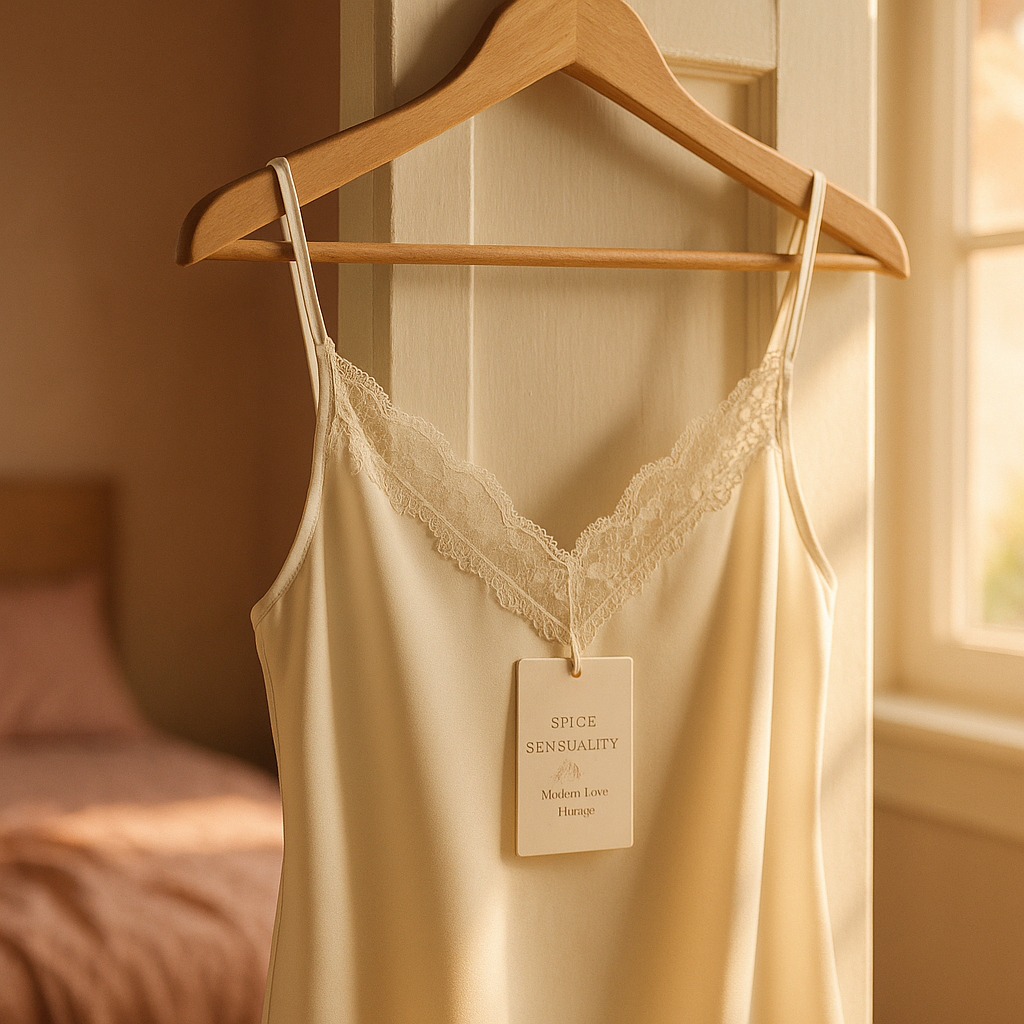
It might be a robe. Heavy cotton or thin silk, something that feels like a choice when you tie it. It might be a set — the kind that matches, the kind that means you went to the trouble. It might be a good simple dress you bought before everything got hard, and you put it on alone on a Tuesday.
It might be something you ordered at two in the morning during a moment of unexpected hopefulness, something that arrived in tissue paper and sat in the drawer for three weeks before you were ready.
The scene is almost always private. No one's coming over. No one's going to see this. That's the entire point.
You stand in front of a mirror or you don't. You might feel stupid for approximately forty-five seconds. Then something settles. Your posture changes by half an inch. Your shoulders drop. You think, oh, there I am.
Why It Works When Nothing Else Does
Talking about it doesn't always work. Journaling doesn't always work. The long bath is nice but it's passive. What works differently here is that you made a decision. You chose something for your body. That is an act of care that is almost shockingly small and almost shockingly effective.
When you've spent a season being managed by circumstances — grief, illness, someone else's needs, your own fear — reclaiming a single decision about your physical self is not trivial. It's a small sovereignty. It counts.
This is also why the article lingerie-for-the-mirror resonates with so many people who aren't even sure they'd call themselves lingerie people. The mirror isn't the point. The choosing is the point.
The Body You're Returning To
Here's the part that takes time to accept: the body you're returning to is not the body you left. Hard seasons change the physical self. Weight shifts. Skin changes. Energy reorganizes. You are not going back to a previous version.
You are making contact with the current one.
That distinction matters because so many people are waiting — waiting for the body that fits old clothes, waiting for the body that felt confident, waiting for the body that someone else validated. That waiting is the thing that keeps you absent longest.
The thing you put on is not a reward for getting back to normal. It's a signal that you're done waiting to deserve it.
If you've read the-size-youre-waiting-to-be-before-you-buy-anything, you already know this pattern. The withholding is the symptom. The purchase — even a small one, even something for no occasion — is the interruption.
What Happens After
It doesn't fix everything. You know that. One garment does not reverse a hard season. You'll probably take it off in twenty minutes and go back to your regular life.
But something has shifted in the direction of toward. Toward wanting things again. Toward caring what touches your skin. Toward the possibility — not the obligation, just the quiet possibility — of desire.
The nervous system noticed. That's enough for today.
You can follow that thread slowly. A bath oil you actually like. A playlist for the room instead of background noise. Reading something that's actually interesting to you again. Maybe eventually reaching for another person — or reaching for yourself, with intention, for the first time in a while. The bedside drawer that maybe needs revisiting.
None of it has to happen tonight. The garment already did the first thing. It said: I live here. This is my body. I'm coming back.
Frequently Asked Questions
How do I start dressing for myself again after a hard period?
Start with one thing, not a wardrobe overhaul. One item chosen because it feels like something you'd want against your skin — not because it serves a purpose, not because it's practical, not because someone else would like it. Something for the body you have right now, in this house, on an ordinary day.
Is dressing in lingerie or nice clothes alone actually helpful?
Yes, and there's a reason for it that isn't mystical. Physical sensation is a direct line to the nervous system. When the nervous system has been in a sustained stress response, sensory input — fabric weight, warmth, texture against skin — helps signal safety and presence. You're not performing. You're reorienting.
What if it feels stupid or sad to do this alone?
It might feel both for about a minute. That's normal. The feeling of slightly-ridiculous is almost always followed by something quieter if you don't leave. Stay in it for a few minutes. Let the moment be unremarkable. The ordinary is what you're trying to get back to.
Does this mean I'm ready to be intimate with someone again?
Not necessarily, and this isn't a checklist. Dressing for yourself is its own complete act. It doesn't obligate you toward anyone. It's possible to reclaim your own body without that meaning you're ready to share it yet — or ever, in some seasons. Let it be about you first. The rest can wait.