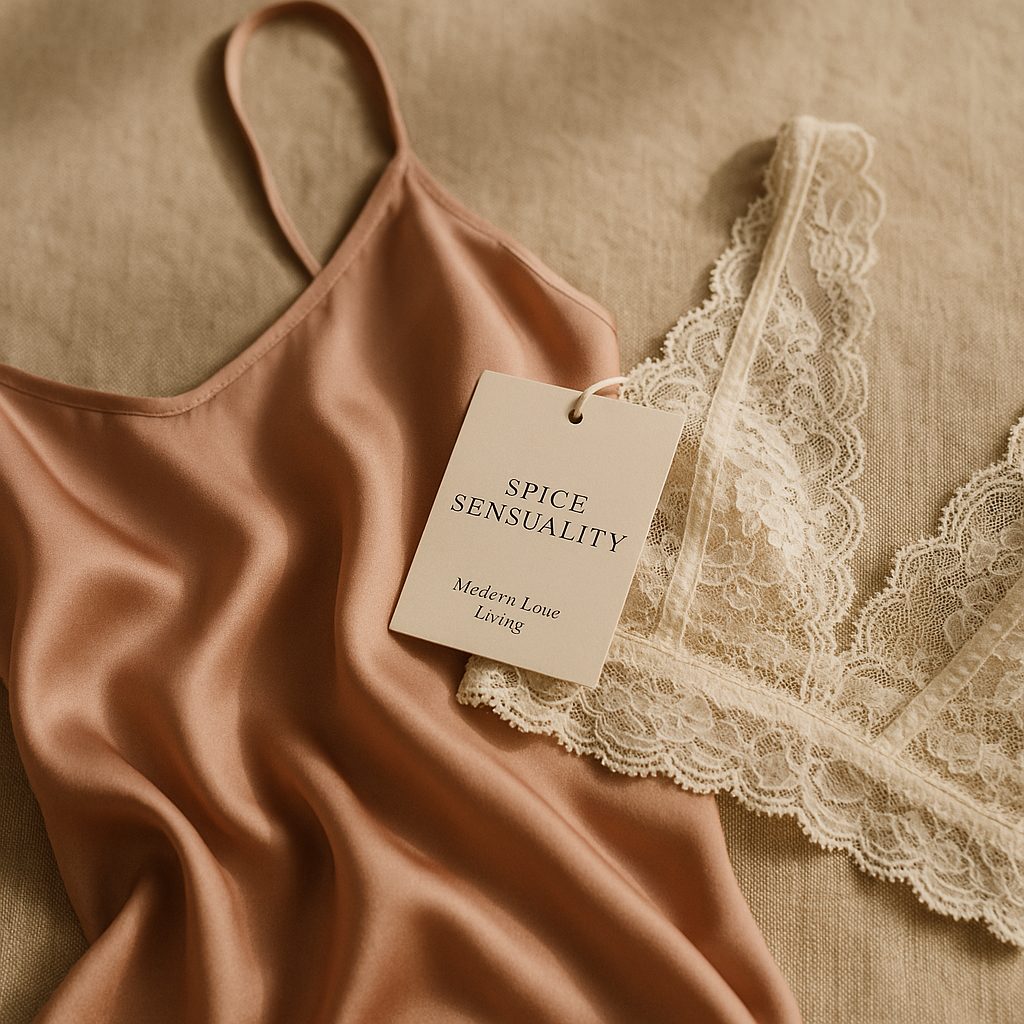
You know the piece. Maybe it's a slip the color of old champagne. Maybe it's a robe so heavy it feels like a hand on your shoulder. Maybe it's just underwear that costs more than you'd admit and fits exactly right. You put it on when no one is coming over. You're not performing. You're not preparing. You just wanted to feel like that version of yourself for a Tuesday night.
Most people don't have language for what that act is. So they call it self-care. Or a treat. They laugh it off a little, the way you do when something feels too close to true.
It's not self-care. It's erotic identity maintenance. And it has almost nothing to do with your partner.
Two Different Hungers
Dressing for desire — the kind someone else receives — is its own art. You're reading a room, a person, a version of yourself that wants to be wanted. There's heat in that. There's nothing wrong with it.
But it's a relational act. You're in dialogue, even when they're not in the room yet. You're imagining their eyes. What you choose is partly chosen for them.
The other thing — the champagne slip on a Tuesday, the silk you bought in Healdsburg and didn't tell anyone about — that's something different. That's you checking in with your own erotic self. Confirming it's still there. Still yours.
Where the Confusion Comes From
Most of us were never taught to separate these. Desire was always framed as relational. You got dressed up for dates. You bought lingerie for anniversaries. The whole category of intimate clothing existed in service of someone else noticing it.
So when you buy something for yourself alone — and feel something when you put it on — it registers as strange. Slightly excessive. Maybe even a little sad, if you're single. Maybe performative, if you're partnered.
Neither read is right. Both miss the point.
She kept buying things her husband would never notice and wearing them anyway. Eventually she stopped thinking of it as strange. She thought of it as the part of herself she wasn't outsourcing.
— MLL reader, submitted
What Gets Lost When You Collapse Them
When you dress only for desire — only for a partner, a date, an occasion — you start to lose the thread of what you actually like. What you reach for becomes about legibility. What will read as sexy to them. What signals what you want to happen.
And it works. But it's a narrowing.
Over time, some people find they don't really know what they'd pick if no one was watching. The lingerie drawer becomes a costume rack. Everything in it is a prop for a scene with someone else in it.
Meanwhile, if you dress only for yourself — only ever a private act, never brought into contact with anyone — you can wall it off in a way that also costs you. Your erotic identity becomes a secret even from your own intimacy. You know who you are alone in the bathroom. Your partner never gets near that person.
That's not integrity. That's compartmentalization with nicer fabric.
The Mirror Is Not Vanity
There's a moment — you know this moment — when you've put the thing on, and you stand in front of the mirror, and you look at yourself for longer than feels socially acceptable. Not checking. Actually looking.
That's not vanity. That's contact with your own desire. You're not looking for flaws. You're looking for the self that lives inside this version of how you've dressed.
It's a check-in. Are you still in there? Good.
The weight of a good robe. The drag of silk across the hip. The specific way lace sits against skin that's warm from a shower. These are sensory facts. They tell you something true about your body and how it wants to be known — by itself, first.
How This Actually Shows Up in Relationships
People in long partnerships often report a specific drift: they stop feeling sexual in private and only feel it when desire is explicitly on the table with their partner. The pilot light goes out when no one's watching.
This is worth paying attention to. Because if the only version of yourself that exists erotically is the one facing someone else, you're not bringing an erotic self to the relationship. You're constructing one on arrival.
That's exhausting. And it explains some of the drag people feel around desire in year four, year seven, year eleven.
What Solo Dressing Is Actually Training
When you put on the thing for yourself, you're practicing a kind of erotic presence. You're staying fluent in your own desire. You're keeping the frequency alive.
This is not separate from your partnership. It feeds it — indirectly, without theater.
You're also learning preference. What you reach for when no one's watching tells you who you are, erotically, without the noise of audience. That information is useful. It belongs to you first. But it doesn't have to stay only yours.
Some of the best moments in a long relationship happen when someone lets the private self out briefly: the thing they wear for themselves, worn now in front of their partner without explanation or occasion. Not as a performance. Just as an introduction. This is also me.
The Actual Question
When you opened the drawer this morning — or didn't — what were you thinking about? Were you thinking about your body, your day, the weight of what you wanted to feel against your skin? Or were you already thinking about someone else's reaction?
There's no wrong answer. But there's a useful one.
If the answer was always someone else, that's the narrow place. The narrowing is quiet. It happens in small choices over a long time.
The reclamation is just as quiet. It starts with one thing. The robe. The slip. The underwear that nobody's seen yet. You put it on, you close the bathroom door, and you stay in there a little longer than necessary.
Not for them. Not instead of them. Just: for this.
Frequently Asked
Is buying lingerie for yourself a sign that something is missing in a relationship?
Usually, no. Dressing for your own erotic identity is not compensation — it's maintenance. The confusion comes from assuming that intimate clothing only exists in relation to a partner. It doesn't. Keeping your own erotic self alive between shared moments is actually what makes those moments possible.
What's the difference between dressing for desire and dressing for yourself?
Dressing for desire is relational — you're in dialogue with someone else's gaze, real or imagined. Dressing for yourself is private contact with your own erotic identity: what you want to feel in your body, how you want to inhabit yourself when no one is performing or receiving. Both matter. Both are incomplete without the other.
How do I reconnect with my erotic identity after a long relationship?
Start with what you'd choose if no one would ever see it. Not what you think is sexy in general — what you'd actually reach for. A fabric. A weight. A color. Something that makes you feel like yourself rather than like a character prepared for a scene. That's the thread. Pull it.



