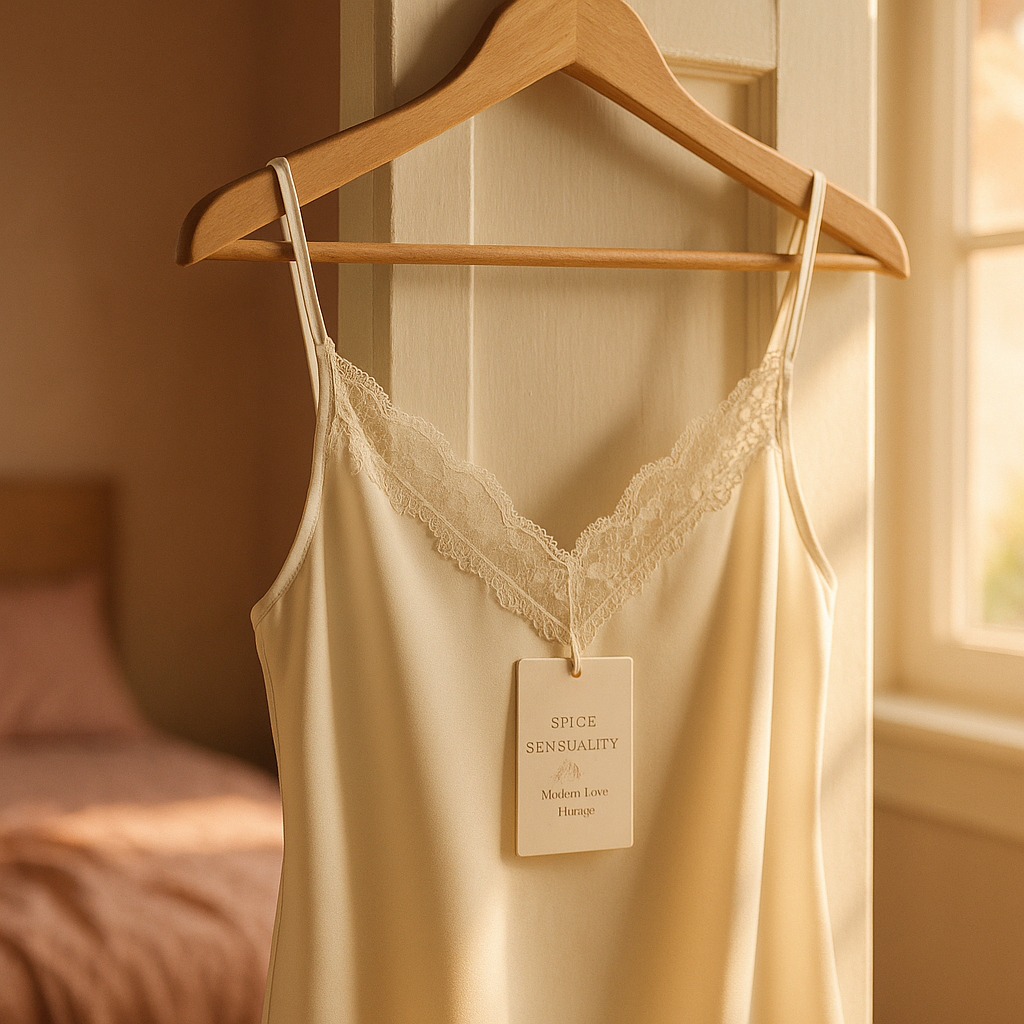
You know the one. It might be a robe. Might be a specific pair of underwear that nobody has ever seen. A slip. A knit that's too warm for the season but you put it on anyway at 9 PM when the day finally releases you. Whatever it is, you reach for it when you need to come back to yourself.
Not for anyone else. Not even a little.
The Audience You're Dressing Without
Most of us spend our entire relationship with clothing managing other people's perception. The work outfit that reads as capable. The date dress. The lingerie chosen because of how it will land on someone else's face when they see it.
All of that is fine. But it's a completely different act than this one.
This one happens alone. In a bathroom with the door closed, or a bedroom while your partner is watching something in the other room, or at 6 AM before anyone else is awake. You put the thing on. And something in your chest settles.
What Your Body Already Knows
Sensory input is not neutral. The weight of a heavy robe is different from the weight of a light one — and your body responds to that difference before your brain finishes registering it. The silk of a slip against the back of your thigh. The slight pressure of an underwire you actually like. The specific scratch of a linen shirt that, somehow, feels like permission.
These are not aesthetic preferences. They're signals. Your skin is sending information upward, and your nervous system is filing a response.
This is the thing the lingerie conversation almost never touches. We talk about lingerie as performance, as desire, as something you wear toward someone. But some of the most intimate pieces people own are the ones that never leave the house. The ones that exist entirely to recalibrate.
I have this silk camisole I bought at a small shop off the Healdsburg plaza three years ago. I've worn it maybe sixty times. My partner has never seen it. It's just mine. I put it on when I need to remember I have an interior life.
— Reader, submitted anonymously
The Ritual Is the Point
It's not just the garment. It's the sequence. The act of changing out of the day — the specific removal of what you were performing in, and the deliberate putting on of the other thing. That transition is doing work.
Think about what you actually do. You might light something. Run a bath you'll sit in for twelve minutes before it's too cold. Pour a glass you'll drink half of. The garment is part of that sequence: a physical marker that says the day is done and something else has started.
This is why the specific item matters so much. It can't be just any robe. It's that robe. The waffle-knit one that's gotten softer every wash. The silk one that feels like it was cut for someone who takes themselves seriously. The oversized shirt that belongs to you so completely that the idea of wearing it anywhere public would ruin it.
Why It Has to Be Private
Here's the part that's worth sitting with. Sometimes the most intimate thing in your wardrobe is the thing no one has ever seen on you. Not because you're hiding it. Because being seen in it would change what it does.
The moment it becomes something worn for someone, it starts managing their response. And you lose the only thing it was ever for: managing yours.
This is not a relationship problem. It's not about withholding. It's about preserving one small frequency that belongs entirely to your own interior. Long-term intimacy actually depends on people having those. The alternative is that everything you wear and do and feel is in relationship to another person — which sounds close but functions more like disappearing.
What This Actually Looks Like
For some people it's a specific fabric: heavyweight cotton that feels like a decision. For others it's warmth: the kind that settles over your shoulders like a hand. For others it's the absence of something — no waistband, no underwire, nothing asking anything of your body.
One person I know changes into a specific thin-strapped satin slip the moment she's home from anything that required performance. She told me she doesn't fully trust herself to make decisions until she's in it. That's not an exaggeration — that's just her knowing how her nervous system works.
Another keeps a particular knit cardigan he bought years ago at a market in Yountville. He puts it on when he needs to write something honest. He says it has no function except that one.
The specifics vary. The mechanism is the same: a physical object that signals your body into a particular internal state. Not performance. Not desire directed outward. Just you, returned to yourself.
How to Find Yours If You've Lost the Thread
Some people read this and immediately know what their thing is. Others realize they don't have one anymore — that somewhere in the optimization of adult life, this particular category of object got phased out.
Start with sensation, not aesthetics. What weight do you want on your body when no one is looking? What texture do you reach toward? Heavy and containing, or light and barely there? Do you want to feel wrapped or released?
The second question is harder: when do you need it? Identify the moment in your day or week when your shoulders are the highest. That's when the object earns its place.
Then protect it. Don't explain it. Don't loan it. Don't photograph it for the internet. Some things work precisely because they have never been looked at.
The Intimate Thing Nobody Talks About
The relationship between clothing and desire is usually framed as outward-facing. What you put on before someone sees you. What signals you send. How you're read.
But the most erotic thing about knowing your own body — what it needs, what it responds to, what brings it back online — is that it makes everything else better. You can't be truly present with another person if you've lost the frequency of your own interior.
The robe. The slip. The thing you reach for when the day is done. It's not trivial. It's foundational. It's how you know who's showing up — to yourself, and to everyone else.



