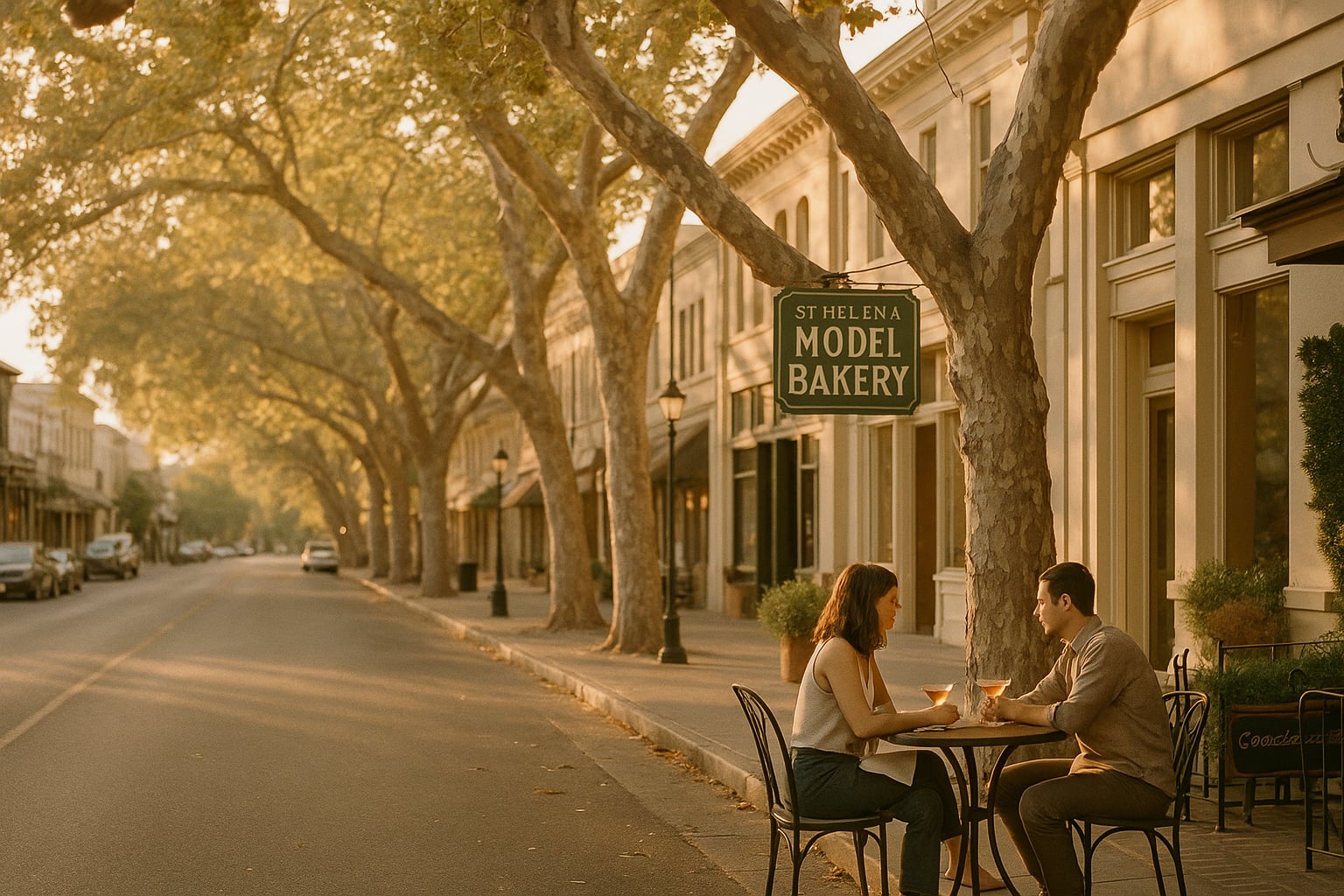
You met at a winery in Healdsburg. Late afternoon light. A pour of something cold and orange. You talked for three hours and couldn't stop. By the time you drove back down the 101, you were already rewriting your future.
Six weeks later you're standing in their kitchen watching them ignore a sink full of dishes and you cannot locate that person from the winery anywhere.
That's not a red flag. That's situational chemistry doing what it always does: disappearing when the situation ends.
What Situational Chemistry Actually Is
Situational chemistry is real. It's just not about the person. It's about the conditions you were both inside when you met.
Vacation. A work conference away from home. The warm, low-stakes atmosphere of a tasting room or a long dinner with nowhere to be. New city, temporary apartment, the specific freedom of being far from your actual life.
In those conditions, most people are slightly better versions of themselves. More open. Less defensive. Not carrying the week. And so are you. So the conversation flows, the attraction amplifies, and your nervous system files it all under this person when the correct label is this context.
The Conditions Do a Lot of the Work
Think about what a place like Solage or Indian Springs actually does to people. Warm mineral water. No cell service worth having. The physical loosening of bodies that have been desk-bound for months. Everyone there is already softened before a single word gets exchanged.
Add someone new. Someone curious and temporarily unhurried. The chemistry that emerges isn't manufactured — it's genuine. But it's also situationally dependent in a way that feels invisible until the situation is gone.
The same dynamic works online. A late-night thread. Two people alone in their respective dark apartments, phones warm in hand. The intimacy of 1 a.m. text exchanges is its own manufactured environment. It lowers guards, blurs the ordinary friction of being a real person with a real history.
You're not seeing them. You're seeing the version of them that exists at 1 a.m. with the lights off and nothing to lose yet.
Why It Feels Like Compatibility
Because compatibility has a feeling. And situational chemistry mimics it almost perfectly.
The ease. The sense that you don't have to explain yourself. The physical pull that makes you think: finally. That fluency in early conversation where everything lands and nothing is awkward. Your brain interprets all of it as a signal about the person when it's actually a signal about the moment.
We kept saying we had such great chemistry. Looking back, we were both just really happy to be in Yountville for the weekend and not talking about work.
— unnamed, 34
Compatibility, real compatibility, is what's left when the context stops helping. It's how someone handles a bad Tuesday. Whether you can be boring together without it feeling like failure. Whether the silence that falls between dinner and bed feels like rest or distance.
The Tuesday-Night Test Nobody Wants to Take
Tuesday night is not romantic. It's not a first date and it's not a weekend away. It's both of you slightly depleted, faintly annoyed at something that happened at work, navigating what to eat and who's more tired and whether either of you actually wants to talk.
Tuesday night is the test. And situational chemistry does not study for it.
Compatibility shows up in the micro-moments most people don't even name. Whether they make space for your silence or take it personally. Whether you can be in the same room doing nothing without performing. Whether a low-energy night together feels like relief or like something is wrong.
If every ordinary night together feels like a disappointment compared to how it felt at the start, that's information. Not about your relationship dying. About what was real in the first place.
This Doesn't Mean What You Had Wasn't Real
It was real. The connection, the heat, the sense of possibility. None of that was a lie.
It just lived inside a set of conditions that couldn't last. And here is the part people don't say out loud: that's okay. Some connections are built for that context. A summer. A trip. A season of your life when you needed exactly that kind of electricity.
The mistake isn't feeling it. The mistake is insisting it means something permanent before you've let ordinary life anywhere near it.
How to Tell the Difference in Real Time
You probably can't tell in the first month. That's not a failure of perception. The chemicals are too loud.
But there are signals worth noticing. Does the intensity require novelty to sustain itself? Are your best moments always somewhere else: a trip, a restaurant, a hotel, a night with wine and no responsibilities? Do ordinary settings create a flatness you both pretend not to feel?
Compatibility tends to feel different. Less electric early, sometimes. But steadier. The sense that you can be the lesser version of yourself on a hard day and something still holds. That you don't need the location to do the heavy lifting.
One more signal: how does it feel to be seen when you're not on? Situational chemistry often can't survive that. Real compatibility is built almost entirely of it.
What to Do If You're Already In It
Stop trying to recreate the conditions where it worked. That instinct — booking another weekend, finding another restaurant that approximates that first dinner — is a way of feeding the situation instead of testing the relationship.
Let Tuesday exist. Let a night at home with nothing planned and mild irritation be part of the record. You're not killing the spark. You're finding out what was actually underneath it.
Sometimes what you find is real. The ease is still there. The warmth survives the mundane. The attraction doesn't require candlelight and a good pour to show up. That's worth something significant.
And sometimes you find out that you loved the version of them that existed in those conditions, and that version simply doesn't live here. That's not a tragedy. That's clarity.
The winery version of someone is always a little better than the Tuesday version. So are you. The question isn't which version is real. It's whether the Tuesday version of both of you can build something worth staying for.