It's not just a fantasy. It's that fantasy. The one where there's a specific chair, or a specific hour of the afternoon, or something left on a nightstand. You've run it enough times that you know every detail. And you've probably also wondered, somewhere quietly, why it has to be so specific.
Here's the thing. The specificity isn't the weird part. The specificity is the whole point.
Props Don't Appear by Accident
A fantasy that requires a prop — silk rope, a particular glass of wine, a piece of clothing still half-on, a blindfold sourced from a specific drawer — is doing something a prop-free fantasy isn't. It's being precise. And precision in desire is rare enough that when it shows up, it's worth paying attention to.
The object anchors something. It creates a container for a feeling that's otherwise hard to hold. The blindfold isn't about not seeing. It's about permission to stop performing. The silk isn't about texture. It's about a version of yourself that moves differently, expects more, takes up more room.
Strip the prop out of the scene and the scene collapses. That's not incidental. That's data.
What the Room Is Telling You
Most people focus on the person in the fantasy. But the setting is carrying just as much weight, sometimes more. The room, the light, the time of day — these aren't decoration. They're the emotional conditions under which the thing you want becomes possible.
Late afternoon light through a sheer curtain means something different than a dark room at midnight. A hotel suite in Healdsburg where no one knows where you are means something different than your own bedroom with its ordinary gravity. The slow-drain of a deep soaking tub at Solage, steam, the specific weight of silence — all of it is doing work.
If your fantasy only works in a specific place, you're probably telling yourself that you need a context where the normal rules don't apply. That's not neurosis. That's self-knowledge wearing a costume.
The Prop as Proxy
Sometimes the object is a proxy for a dynamic, not a thing. A prop that transfers control — a blindfold, restraints, something that stays on while other things come off — is usually a proxy for the relief of not being in charge. Which is interesting if you're someone who's in charge all the time.
A prop that enhances sensation — oil warmed in a palm, something cool against skin, weight pressing down — is often a proxy for wanting to be fully present in a body you normally treat as a vehicle. You live inside your head so much that you've written an entire scene to get you back into your skin.
A prop that's about appearance — specific lingerie, a particular item left on rather than removed — is often a proxy for wanting to be seen as a specific version of yourself. Not better. Just more precisely you.
The fantasy isn't the destination. It's a very detailed set of directions to a need that doesn't have another way to speak.
Why Rehearsed Fantasies Get More Specific Over Time
If you've had the same fantasy for years — and most people have a few they return to with the loyalty of a subscription — you've probably noticed it gets more detailed, not less. The prop becomes more specific. The room sharpens. The sequence tightens.
That's refinement. You're not obsessing. You're narrowing in on the thing underneath the thing. Every detail you add is a clue you're leaving yourself.
The fantasy you've rehearsed alone for years isn't frozen in time. It's been quietly updated every time a new piece of information arrived. A trip you took. A relationship that changed something. A version of yourself you glimpsed and then lost. The prop that got added two years ago probably arrived around the same time something else shifted.
How to Actually Read the Map
You don't need to decode the whole thing at once. Start with one question about the prop itself: what does having it in the scene make possible that wouldn't exist without it?
Not what does it do physically. What does it allow? What permission does it grant? What rule does it suspend?
Then ask the same question about the room. About the light. About the time of day. If the fantasy only works at 3pm on a Tuesday when no one is coming home, you're probably telling yourself something about stolen time — about desire requiring a window that no one can interrupt.
Bringing It Into the Room With Another Person
This is where most people stall. The prop-dependent fantasy can feel too specific to say out loud. Too revealing. Like handing someone a map to something embarrassing.
But here's what's true: the specificity is exactly what makes it shareable. Vague desires are hard to act on. A specific one gives someone something to work with. "I want to try something" is a door with no handle. "There's a scenario I've been thinking about and it involves this particular thing" is an actual invitation.
You don't have to share the whole decoded meaning. You can just bring the prop. Put it on the nightstand. Let it be a question rather than a speech.
The object will do some of the talking for you.
The Bedside Drawer as Honest Archive
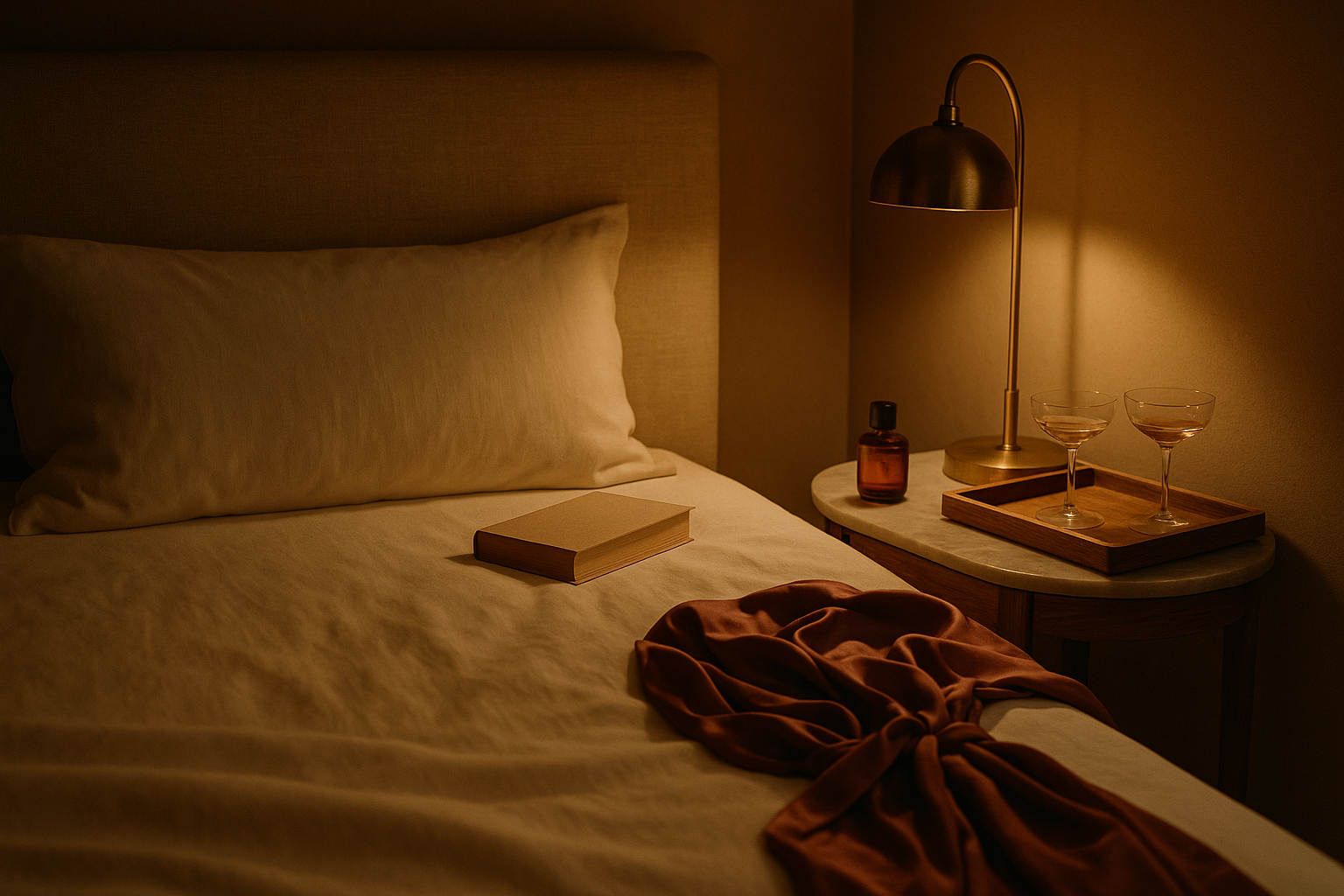
What you keep near the bed tells a fairly honest story about what you want and haven't quite asked for yet. Not the emergency-backup stuff or the practical items. The things you moved deliberately, or bought and then felt slightly strange about, or kept from a night that mattered.
If there's something in there that's connected to a recurring fantasy, it didn't get there by accident. Someone put it there with intention they didn't finish acting on.
That's not failure. That's a draft waiting to be finished.
The fantasy that requires a prop isn't more complicated than other fantasies. It's just more honest about what it needs. Which, when you think about it, is the whole challenge. Most of us can say what we want in general. The specific ask — the exact thing, the exact condition — is where desire gets vulnerable and real.
The prop is a very small, very specific door. And you've been standing outside it for a while now.