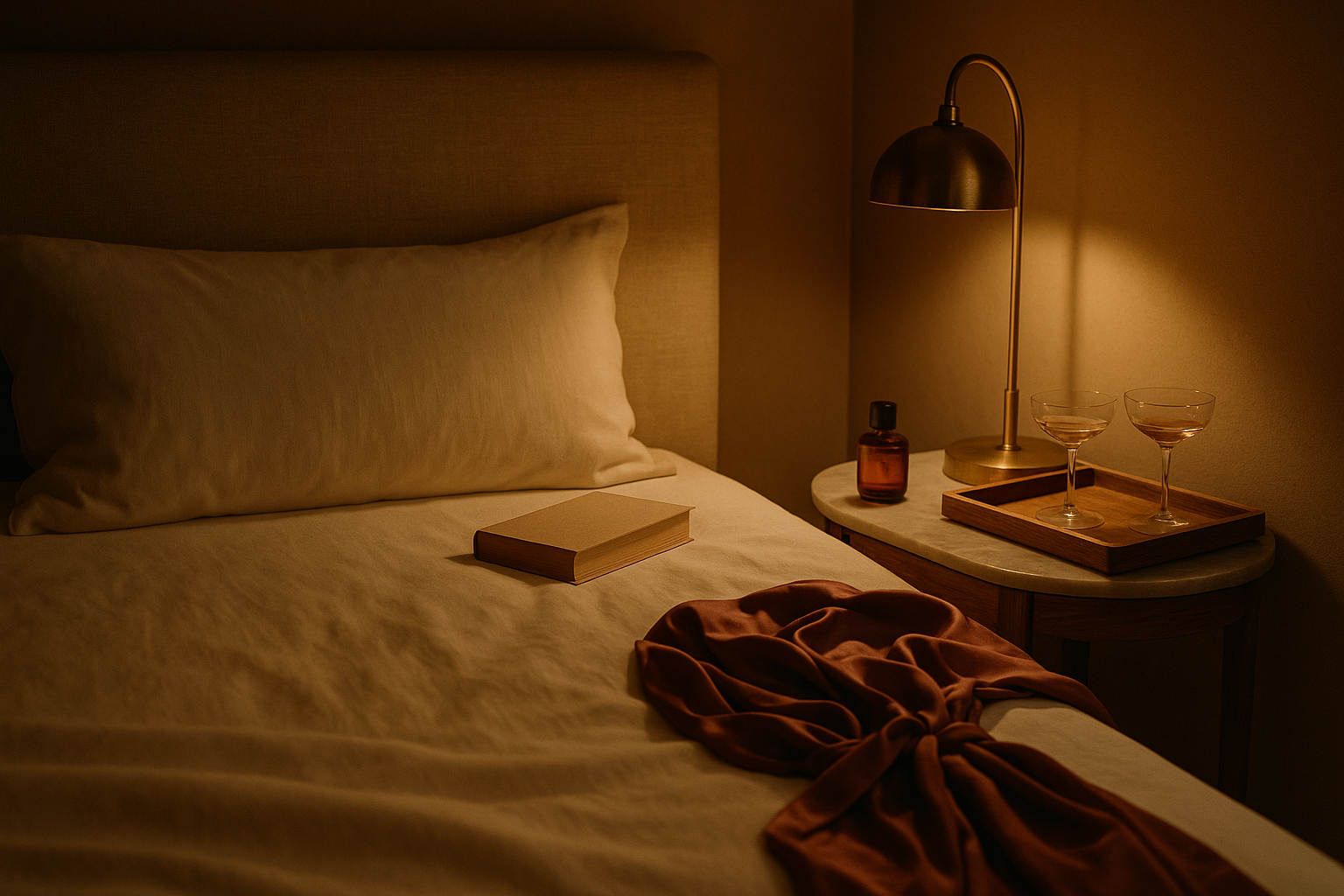
You know the version of yourself that comes out alone. Maybe it's the walk you do across the apartment when you're running late and the music is too loud to care. Maybe it's the voice you use when you're rereading a text you're proud of. Maybe it's the way you catch yourself in the bathroom mirror at Solage, still half-wrapped in a towel, and hold the look for a beat longer than necessary.
That version has a character to it. A posture. A temperature.
Most people never name it. They just know it exists, and they protect it fiercely — not because it's shameful, but because it's theirs. Unmarked. Unhanded-over.
What We Actually Mean by a Private Performance
This isn't about roleplay in the obvious sense. It's earlier than that. It's the internal casting you do when no one can see the audition.
The person who's a little colder, a little more decisive. Or warmer, actually — softer than you let yourself be in company. The one who moves differently. Who wants out loud, without apology.
Some people rehearse through fantasy. Some through clothing — sliding into something they never wear around their partner, not because it's wrong, but because the feeling it produces belongs to a self that hasn't been introduced yet. Some do it through music, or through the particular way they narrate their own life in their head like a scene someone else is filming.
Why It Stays Alone
Partly it's embarrassment. Not the hot kind. The cold, specific embarrassment of showing someone a version of yourself that doesn't match the version they've catalogued.
Long relationships are especially prone to this. You've been filed. There's a folder with your name on it and your partner knows which drawer it lives in. Introducing a character who doesn't match the file feels like a correction — and corrections, even good ones, imply that what came before was wrong.
It's also just: vulnerability of a weird shape. Most intimacy conversations focus on feelings, history, needs. This is different. This is handing someone a costume and saying I put this on when you're not here and I like who it makes me.
That sentence is harder to say than most people expect.
The Rehearsal Isn't the Problem
Here's the reframe: the solo rehearsal is not a symptom of distance. It's a drafting process. You're working something out.
The question worth sitting with isn't why do I have a private version of myself. Everyone does. The question is whether that version is getting more interesting while the shared version quietly stagnates.
The parts of ourselves we only perform alone don't disappear. They either find a stage or they find a resentment to live inside.
— MLL
That second option is quieter and more common. It shows up as vague dissatisfaction. As the feeling that your relationship is fine but somehow doesn't fit right anymore — like a garment you bought for a body you no longer quite inhabit.
What Bringing It Into the Room Actually Looks Like
It doesn't have to be a conversation. In fact, a direct conversation might be the wrong move first.
Sometimes you bring the character in through a garment. You wear the thing you usually only wear alone. You let it sit in the room and see what it does to the air. This is what lingerie for the mirror is actually about — the solo ritual first, then the decision of what to share.
Sometimes you bring it in through a scenario. Not a scripted one. Just: a setting that gives the character permission. A late check-in at a Healdsburg inn where you don't know anyone. A drive down a Sonoma backroad with no plan, which changes how both of you hold yourselves in the car.
Sometimes you just say it badly. You say: there's a version of me you haven't really seen yet. And then you wait, and the silence either opens or it doesn't.
The Scenario Most People Have But Don't Name
Picture this: she's been someone specific in her head for years. Not a different person — just a specific temperature of herself. More authority. Less explaining. The kind of presence that takes up the right amount of space in a room.
She plays it alone. The walk, the pause before speaking, the way she chooses her words like she isn't worried about the landing. It's not fantasy in the sexual sense — or it's not only that.
Her partner hasn't met this version. Not because it was hidden. Because the moment never came up and then enough time passed that introducing her felt like a reveal at a party where everyone thought they already knew the guest list.
One evening she just doesn't explain herself. Doesn't soften the take. Doesn't trail the sentence with a question mark she doesn't mean. The character shows up, not announced, just present.
Her partner notices. Doesn't say anything. But later: you seemed different tonight. And the answer — yeah, a little — is the beginning of something.
Why This Is a Couples Intimacy Question
Because desire follows novelty, and novelty doesn't have to be a new person. It can be a new facet of the same one.
The private character you've been playing alone has texture. Heat. Specificity. It's been refined in private, which means it's actually ready — more ready than an unexplored fantasy that hasn't been tested against reality yet.
Bringing it into the room is an act of intimacy that doesn't look like intimacy. It looks like confidence. It looks like ease. It looks like someone who knows something about themselves and is no longer rationing it.
One Practical Starting Point
Name the character. Not to your partner — to yourself, first. Give them an attribute. A temperature. One physical thing: how they stand, what they wear, how they start a sentence.
Then pick one small setting where they get to exist outside your head. Not a performance. Not an announcement. Just: room to exist.
If you want a frame for taking that further with your partner — toward actual fantasy and play — the curious couple's first map is a good next stop. Not because this needs to become roleplay. But because you deserve to know which direction it could go, if you wanted.
The character has been waiting. They're not impatient. But they are ready.



