You didn't get a manual. Nobody does. What you got instead was a front-row seat to every couple in your orbit — the ones who kissed in the kitchen, the ones who went quiet at dinner, the ones who seemed fine until they weren't.
And you watched. Carefully. Even when you weren't trying to.
That watching became your first relationship education. Before the first date, the first fight, the first real apology — you already had a working theory of how love behaves. Where it lives in a house. What it sounds like at 10 p.m. Whether it holds or pulls away.
The Curriculum Nobody Names
There's a version of relationship education everyone talks about: the books, the therapy, the podcast you listened to on a walk you needed to take. But the real curriculum started earlier and ran deeper.
It started with your parents standing at the counter, not quite touching. Or very much touching, in ways that made you look away. It started with an aunt who always softened her voice when she talked to her husband, and an uncle who filled her wine glass without being asked.
Small things. Repeated. For years.
Those repetitions built a model. Not a conscious one — more like wallpaper. You stopped seeing it after a while, but it shaped everything about the room.
What You Actually Learned
Some of it was useful. If you grew up watching two people genuinely like each other — laugh at inside jokes, recover from arguments without scorched earth — you probably carried that in as a baseline expectation. A floor, not a ceiling.
But a lot of it wasn't lessons, exactly. It was patterns absorbed as facts.
That one person always wants more closeness and the other always needs space. That desire fades, and you just manage that gracefully or not. That the person who cares less has the power. That silence means safety, or silence means something is very wrong.
You might not even recognize it until you're standing in your own kitchen, doing the same half-turn away from an argument that your mother used to do. And feeling, suddenly, like you've been here before.
The Strangers at the Next Table
It wasn't just the people you lived with. It was anyone you watched long enough.
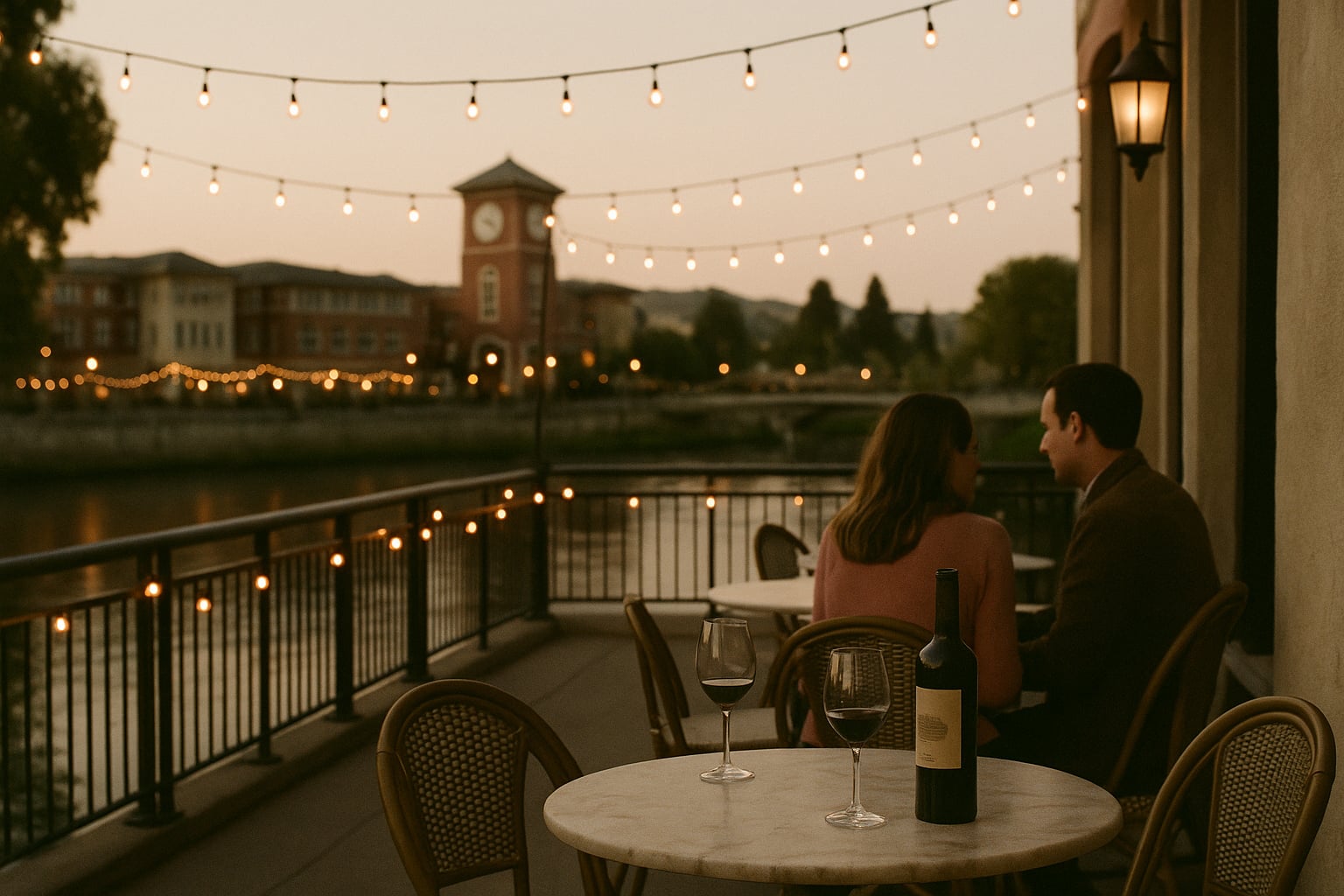
The couple at the restaurant in Healdsburg, the one with the good Pinot and the warm bread, who didn't speak for the first twenty minutes but kept touching hands across the table. You decided they were either deeply comfortable or deeply done. You made a whole story. You took notes.
The couple at the farmers market who bickered about parking in that specific register — clipped, efficient, long-practiced — and then bought each other samples without asking. You filed that too.
You were building a data set. Unconsciously. On what love actually looks like from the outside, which is always partial, always wrong in at least three ways, and somehow still enormously instructive.
The Fictional Ones Did the Most Work
Real couples are complicated and boring in the ways real life is. Fictional couples are designed to be legible. Every gesture lands. Every fight has a shape. The reconciliation comes with music.
And they are relentless. You absorbed hundreds of them before you were twenty.
The ones where desire looks like intensity, like someone cornered against a wall or rain-soaked on a doorstep. The ones where love is proven through grand sacrifice rather than, say, unloading the dishwasher consistently for a decade. The ones where the couple who argues most is secretly the most passionate.
We learned that love that comes easily probably isn't the real thing. Which is an extraordinarily convenient belief for anyone who makes things difficult.
— MLL
This is where a lot of the damage lives. Not in trauma, not in obvious dysfunction — just in the very specific, very seductive picture of what wanting someone is supposed to feel like.
The Expectations Nobody Declared
Here's the part that's hard to see in real time: these absorbed patterns don't feel like expectations. They feel like reality. Like just the way things are.
So when you meet someone who communicates calmly and directly, without the edge you were used to reading as passion, it can feel flat. When someone is consistently present — no hot-and-cold, no chase — it can feel like something's missing.
And when someone mirrors the patterns you grew up with, even the difficult ones, it feels like recognition. Like home. Which is sometimes the same as safety and sometimes very much isn't.
The Reframe
None of this means you're doomed to repeat what you saw. It means you're working with source material, and it helps to know what it is.
The goal isn't to dismantle every model you absorbed. Some of them are good. The aunt who softened her voice — that was worth keeping. The uncle who filled the glass — also useful. The fictional couple who fought every scene and called it chemistry — maybe less so.
It's the ones you never consciously chose that are worth looking at directly. Not to pathologize them. Just to notice: is this actually what I want, or is this just what I recognize?
A Moment That Makes It Real
A woman in her mid-thirties, recently out of a long relationship, describes sitting at a bar in Yountville on a solo trip. At the table beside her, an older couple — maybe sixty, maybe together forever — was eating quietly. No performance. No conversation, really. Just two people occupying the same space like it was the most natural thing in the world.
She watched them for an hour. She said it was the first time she understood what she'd actually been looking for. Not the intensity. Not the grand gesture. Just that: someone who could be quiet beside her and make the quiet feel like something.
She hadn't known to want it. Nobody had shown her.
Until that night, watching strangers eat salmon over candlelight, she finally got a new piece of curriculum.
The watching never really stops. You're still doing it — at dinner parties, in hotel lobbies, scrolling past couples on your phone. The question is whether you're doing it consciously now. Whether you're noticing what you're adding to the model. Whether you're choosing what to keep.