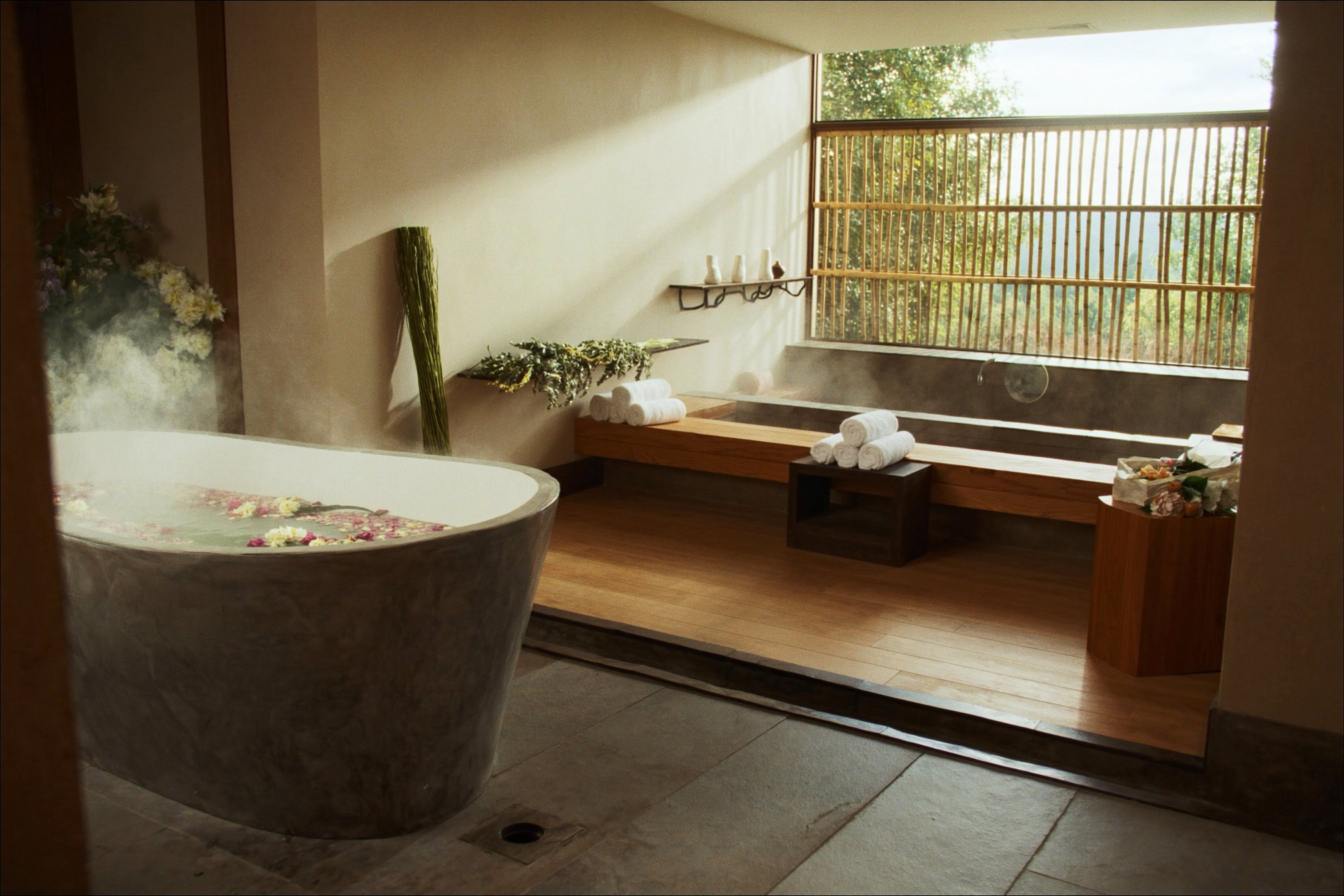
You light the candle. You run the bath. You set your phone face-down on the edge of the tub and let the steam rise. And somewhere in the back of your mind, you're aware that they might walk by. That they might see this. That they might think: she's doing really well.
That's not self-care. That's theater. And most of us have been performing it for so long we forgot there's a difference.
What Performed Wellness Actually Looks Like
It's not obvious. It doesn't feel like performance. It feels like taking care of yourself — which is exactly what makes it so easy to miss.
You go for a walk right after a tense conversation. Not because you need air, but because you want them to see that you're the kind of person who takes space gracefully. You make the smoothie when they're in the kitchen. You mention the journaling. You say I just need a night to myself loud enough to be heard from the other room.
The giveaway: you almost never do these things when you're alone. When they're traveling, the bath doesn't happen. The walk shortens. The whole routine quietly collapses.
The Job It's Actually Doing
Performed wellness usually carries one of a few messages. Sometimes it's: I'm fine, you don't need to worry about me. Sometimes it's: See? I'm working on myself. Sometimes it's quieter than that. It's just proof of competence. Proof of okayness. A bid for a specific kind of regard.
And underneath all of those messages is the same structural problem: you don't fully trust that your actual state — unoptimized, unbathed, genuinely having a hard week — is acceptable in this relationship.
So you stage recovery instead of having it.
Why It Happens in Good Relationships Too
Here's what's uncomfortable: this doesn't only happen in relationships with a critical or demanding partner. It happens in loving ones. Stable ones. Ones where your partner has never once told you to get it together.
Sometimes the performance is preemptive. You've internalized an imagined standard — pulled from your family of origin, from old relationships, from the ambient pressure of living in a world that rewards visible self-optimization — and you're performing for that, not for the actual person sleeping next to you.
Sometimes the relationship is fine but you don't feel entitled to be messy inside it. Not because they've punished messiness. Just because you've decided, somewhere quiet and private, that your full reality is too much.
The bath isn't the problem. The bath is lovely. The problem is needing someone to know you took it.
— MLL
The Micro-Behaviors Worth Noticing
You mention the workout unprompted. You put the supplement bottle somewhere visible. You leave the meditation app open on your phone, homescreen facing up. You say I've been really prioritizing sleep lately in a tone that's half statement, half press release.
None of this is catastrophic. But it's data. It tells you something about where you feel seen and where you feel evaluated.
Pay attention to the specific rituals you announce versus the ones you do in silence. The gap between those two lists is where the actual question lives.
What It Says About the Relationship's Safety
A relationship where you can actually rest is one where your partner has seen you depleted and undone — and nothing bad happened. No withdrawal of warmth. No performance review. No subtle repositioning of who has the upper hand that week.
When that safety exists, you stop broadcasting your recovery. You just recover. The bath happens on a Tuesday with the door closed and you don't mention it. You sit with your coffee in silence, not positioned anywhere, not sending any message.
The goal isn't to stop taking care of yourself. It's to notice when taking care of yourself has quietly become a form of communication — and ask what you're trying to say, and why you can't just say it.
The Reframe: Privacy Is Not Withdrawal
Somewhere along the way, a lot of us confused transparency with visibility. Like being fully present in a relationship means your partner should be able to track your internal state at all times.
Private restoration is not stonewalling. The robe you put on just for you, the walk you don't announce, the half-hour you spend on the back porch in Healdsburg with no one watching — that's not distance. That's the real thing.
When you take care of yourself privately, you bring something actual back into the relationship. When you perform it, you bring back a version of yourself that was managed for an audience. Your partner gets the performance, not you.
One Small Place to Start
Pick one thing you do for yourself and do it entirely without telling anyone. Don't log it. Don't mention it later. Let it be yours.
Notice how that feels. Notice if there's an impulse to report it. Notice if something in you resists the privacy, like an act of self-care only counts when it's been witnessed.
That resistance is the whole conversation.
The version of you that your partner most needs access to is not the one who has everything handled. It's the one who sometimes doesn't — and trusts the relationship enough not to hide it. That trust is what the performance is trying to fake. And you can't fake your way into actually feeling safe.