
The unhurried evening is a beautiful concept and a useless instruction. Most couples agree the principle is right, then fail to execute because nobody told them what 7:42 pm actually looks like. This is that. The minute-by-minute, the kit, the soundtrack, the kitchen choreography, the bedroom transition. The Tuesday night, written out in the way that lets you stop having to design it every week.
It works for the married couple at year twelve. The two women who just moved in together. The man who came out at thirty-eight and is learning what relationship architecture actually looks like. The polyamorous couple coordinating around a third partner's separate Tuesday. The framework holds for any pairing — what changes is the soundtrack and who lights the candle.
The Hour-by-Hour
The Tuesday Blueprint — 5 pm to 11 pm
- 1
5:00 pm — Set the room (15 minutes)
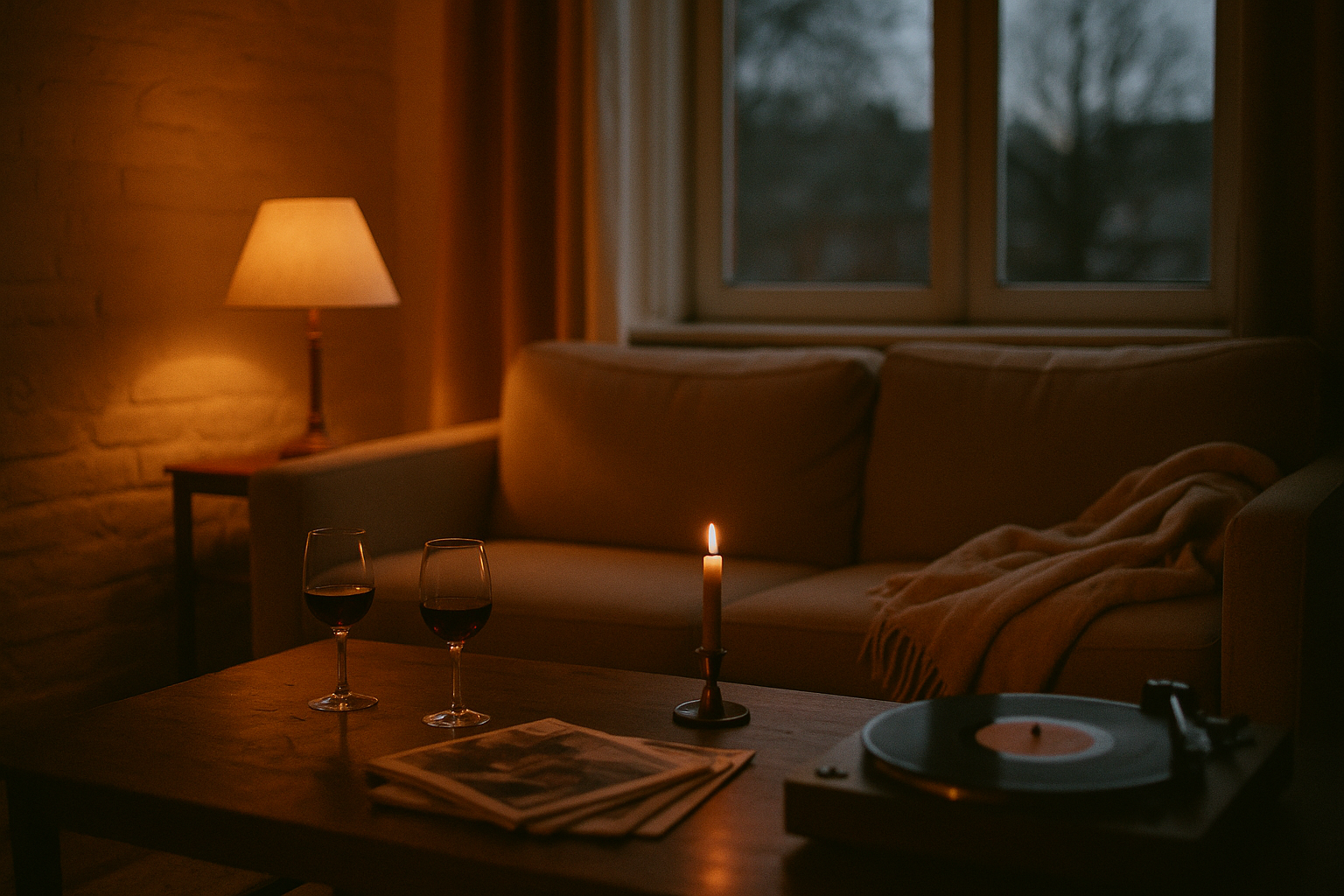
Whoever gets home first sets the room. Overhead lights off. Two lamps on, dimmed to maybe 30%. Candle on the coffee table, lit. Phones go to the bedroom — not the counter, the bedroom. Music starts at 30% volume.
- 2
5:30 pm — Both home, both changed (10 minutes)
You both change out of work clothes, even on a Tuesday. This is the most important thing on the list. The clothes you wore for the boss are not the clothes you wear for each other.
- 3
5:45 pm — Cooking together (60 minutes)
One dish that requires both of you. The ravioli. The bouillabaisse. The roast that needs basting. Standing at the stove together is the single most underrated form of foreplay in a long relationship.
- 4
6:45 pm — Sit down (90 minutes)
Candles lit at the table. Wine decanted. Phones still in the bedroom. You eat for ninety minutes. The conversation should be slower than the food, not faster.
- 5
8:15 pm — Dishes (15 minutes, both of you)
You do them together. Music still going. Dishes are not the end of the evening — they're the bridge to the second half. Both hands wet, both bodies in the same kitchen.
- 6
8:30 pm — The transition (30 minutes)
Move to the couch. New record on. Pour the second glass. Talk, read, kiss, sit close. The transition is the engine of the night — the part where dinner becomes whatever the evening wants to become.
- 7
9:00 pm onward — Whatever the evening wants
Maybe the bedroom early. Maybe two more hours on the couch. The point is that you're no longer running a clock — you're in the version of the night where the evening tells you what it wants. The bedroom is set up — candle on the dresser, oil and lube in reach — for whenever you get there. No fumbling. No rush.
Tuesday Default vs. Tuesday Blueprint
| Default Tuesday | Blueprint Tuesday |
|---|---|
| Eat separately or in front of TV | Cook together, eat at a table |
| Phones throughout the night | Phones in the bedroom from 5 pm |
| Bed by 10:30, screen until 11:30 | Bed by 10:30, no screen, lights out |
| Wake up flat | Wake up close |
| Repeat 50 weeks | Compound 50 weeks → different relationship |
Quick Poll
Which step of the blueprint feels hardest in your house?
Picture This
It's 8:32 pm on a Tuesday. The dishes are done. The candle is still burning. There's a new record on. You and your partner sit down on the couch, and instead of reaching for the remote, one of you turns to the other and says nothing — just leans in. The evening, undecided, has become its own thing.
When was your last 8:32 pm Tuesday like that?
The Tuesday-Night Practice
The First Tuesday
You try the blueprint once. It feels formal, slightly self-conscious. Do it again next week.
Week Three
The room sets itself. The cooking choreography is automatic. You're no longer thinking about the blueprint — you're just running it.
The New Default
Tuesday is Tuesday. Other plans schedule themselves around it. Friends know not to ask.
The Compounded Year
Fifty Tuesdays in. The relationship is different. You don't talk about it. You both feel it.
The unhurried evening as a concept is everywhere. The unhurried evening as an executable plan is nowhere — until now. The blueprint is small, repeatable, and surprisingly resistant to the ways most evenings dissolve. Run it once. Run it three times. By week six, your Tuesday is unrecognizable from the Tuesday you used to have, and the relationship is too.
The full philosophical version — the why behind the what — lives in the pillar essay. Read it for the case. Use this for the calendar.